
Back to Articles
Culture – As Reported in the Local Newspapers
If cultural climate were to be judged by numbers of local newspapers, Meadville would rank as one of the most cultivated towns in the country. More than forty weekly and semi-weekly papers were published here in a period of one hundred and thirty-three years, plus a dozen or more dailies. A political tug-of-war between Democratic and Republican editors took place through the years. Some papers were published for a very short period – one for a year – another for six months. Now and then a publisher would own two or three papers at a time. The Democrats lost the battle and the Tribune Republican became the only paper in Meadville. Many years ago, the name was changed to The Meadville Tribune.
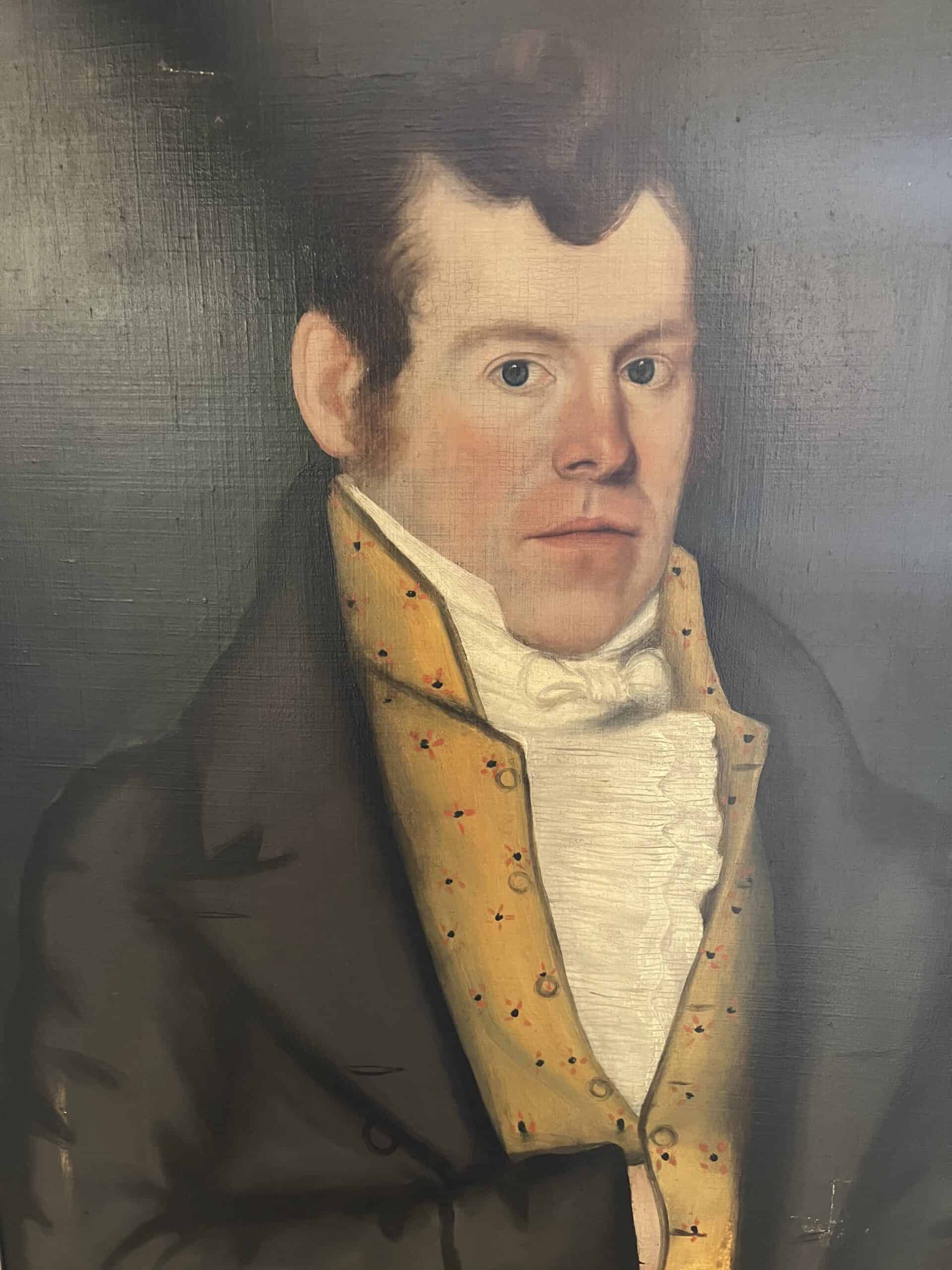
Thomas Atkinson, owned and editor of The Crawford Messenger. Painting attributed to artist James Bowman.
The newspaper I am most interested in is The Weekly Crawford Messenger first published Wednesday, January the second 1805. It was the fourth oldest newspaper west of Pittsburgh and the first in northwestern Pennsylvania. Thomas Atkinson and W. Brendel, his co-editor, were “the publishers, typesetters, editors, pressmen, and delivery boys.” They used a hand press and rag paper brought to Meadville by pack horse from Pittsburgh. The quality of the paper in the copies in the Historical room has kept them in fine condition. In Vol. 1 – No. 1, we find news from Paris dated Sept. 15, 1804 and for Lancaster, Pennsylvania Dec. 6th, 1804.
Among the many items that interested me was that although in 1812 seven years later there were but one hundred and fifty books available for the embryonic Meadville Library, the first editor of the Messenger has a list of books for sale in the editor’s office such as Poetry of Robert Burns, Divine Songs for the Use of Children, Dialogues on the Nature, Design and Evidence of Swedenborg, Economy of Human Life, and New England Primers.
The paper often announced letters still waiting in the Post Office to be picked up. A man named S. Moore – in the “Wanted” section asked several times for a boy, aged between 12 and 15 as an apprentice in the saddling business.
In the third week of publication we find a long article on “The History of the Grand Insurrection or Struggle in Ireland.” On Feb. 20, we learn that an H. J. Huidekoper is opening an office as Agent for the Holland Land Co. There is a list of books that could be ordered from Pittsburgh – Darwin, Newton, Addison, Blackstone, and school books in all languages.
According to the early newspaper, some men of the town are having wife trouble: “Whereas my wife Lucy Brawley has never lived with me in the character of a wife I therefore caution all persons not to credit her on my account as I am determined not to pay anything of her contracting unless compelled by law.”
And the pathos or perhaps of bathos of a man named David McKee who has it published in the paper that his wife, Jennet has left his bed and board without cause. For certain there are two sides to every story…it’s a shame the other one has been lost to history.
The Crawford Messenger continued publishing through 1835. In 1834 it states that the flour trade is depressed and supplies low. They write that Allegheny students are starting a literary society. During the last year of the paper, William Harrison is running for president. There is an article that says “Sir John Herschel has discovered from his observatory on the Cape of Good Hope that he sees not only the moon but animals and men on it,” but, the Messenger adds, “this statement has turned out to be a hoax.”
These bits and pieces do not do justice to a very fine newspaper – it contains interesting and literate writing by the editors, and it was a newspaper that would compete well with any of its time.
Allegheny Magazine, the Unitarian Essayist, and the Chautauquan…Oh My!
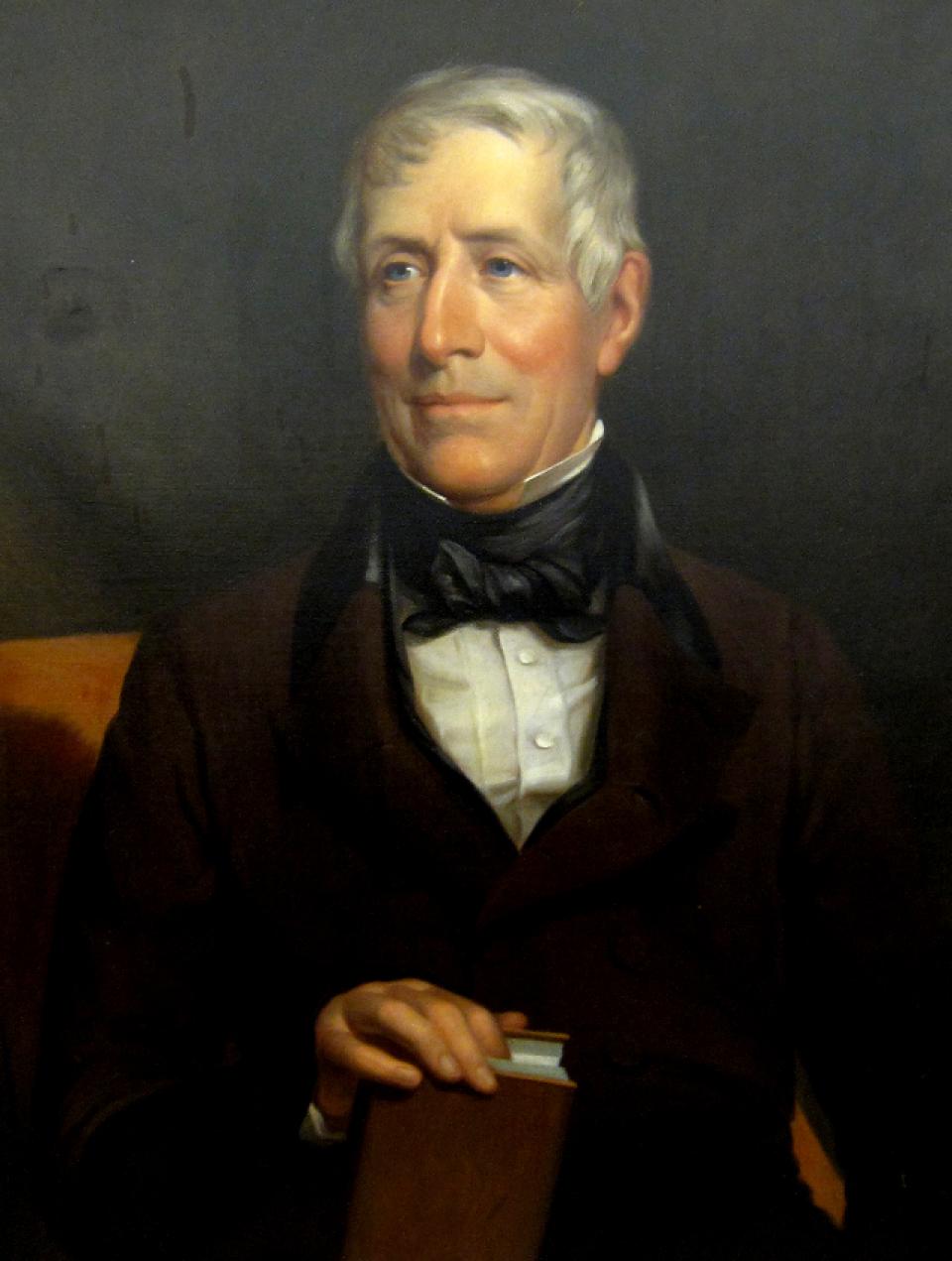
Harm Jan Huidekoper from a painting by John Nagle, Collection of the Crawford County Historical Society
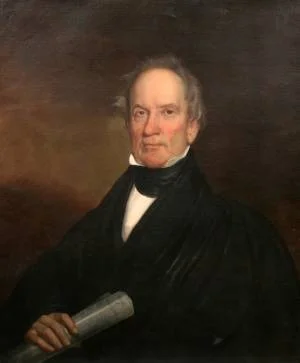
Timothy Alden
Two other early publications should be mentioned, a monthly published in 1816 that lasted one year. The Allegheny Magazine, which was a forum for Timothy Alden‘s missionary zeal, and the Unitarian Essayist that came out in 1831 and 1832. The editors were a Mr. Peabody and Harm Jan Huidekoper and was devoted to theology and philosophy, and of course, was a platform for their Unitarian beliefs. (For more of Alden and Huidekoper’s differing cultural perspectives, see part one of this article). I did not see a copy of the Essayist, but I was able to look through the Allegheny Magazine. This Report on a Conversion is an example – “In the city of Philadelphia a very animating revival commenced in January last – a deep, silent and awful work – attended by pungent convictions of sinfulness and misery continued for some time. The good work still continues.”
There are accounts of the weather – lists of donations to the College – a report on an arsenal to be built in town.
Alden had articles about the Indigenous Peoples in this area and was very knowledgeable about them. With what we know of Timothy Alden, I suspect even his interest was inspired by his missionary spirit.
There is an article in the Allegheny Magazine about an organization called “The Female Cent Society.”
To be brief: Article one of its constitution says that the Society is established to promote the interest of true religion – Article 2 – Dues are to be one cent a week. In the first year the women collected seventy dollars to be sent to Calcutta “to aid in translating holy scripture into the language of Asia.” Asia had only one language?
The Allegheny Magazine includes an address to young ladies on proper ways to indulge in writing and reading – not bad advice, but warns against reading novels – saying that novels are mere chaff “in the form of a gilded pill they contain the fatal poison.”
In March of 1817, we find the inaugural address of the newly elected President, James Monroe.
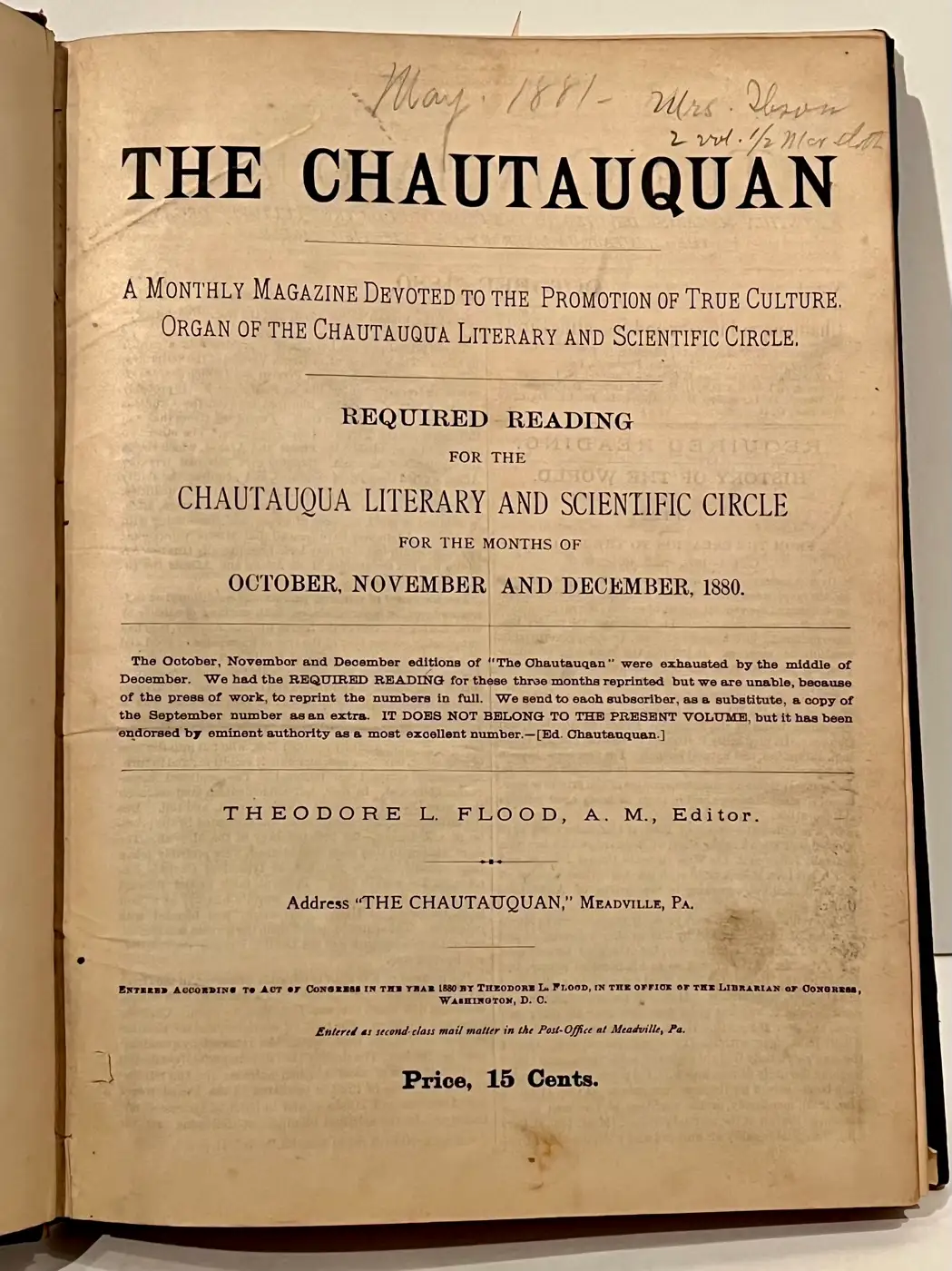
Chautauquan Magazine
Perhaps Meadville’s most unique publication was The Chautauquan, first published in 1880. Born out of Chautauqua, the church, mainly Methodist, Sunday School conferences – and Chautauqua lectures, it had a long and popular career. Had it been a movie, it would have been rated G. Its peak circulation in the 1890’s rose to 100,000. It attracted current writers as well as subscribers and lasted 34 years. It fathered pamphlets, booklets and reading clubs, and its unique influence deserves a study in depth. To quote Frank Chapin Bray writing in the Sesquicentennial:
“To look back over lists of contributors is to find an extraordinary name array of representative American educators, authors, public personalities of the period, characterizing the standard set by the magazine.” Looking back on it, we may be inclined to criticize its book lists and pamphlets as being encapsulated culture for required group reading, yet perhaps it was a prototype for the Great Books groups of the 1950’s.
Samuel P. Bates’ First and Lasting Impressions With Meadville
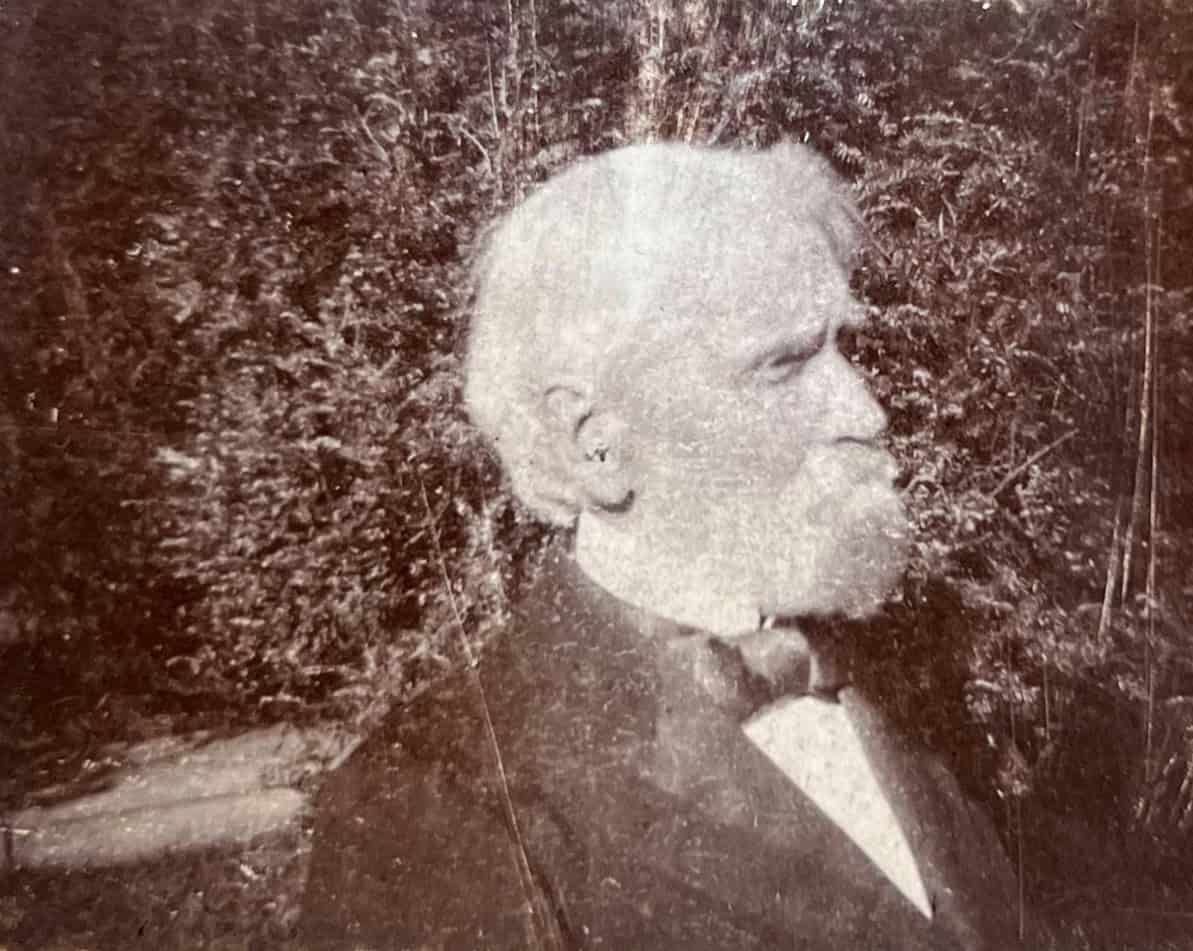
Samuel P. Bates
I am going to go back to 1852 and read a letter written by Samuel P. Bates as a round-robin to his family, when he first arrived in Meadville in August of that year. He was 25 years old, a recent graduate of Brown University, coming as Principal of the Meadville Academy. He came by train as far as Erie from New England, but to save time we will begin with his trip down from Erie and his first reactions to the Meadville community. It is a delightful letter and all of it is in the Historical Room.
“From Erie to Meadville we came by stage. This ride was not so tedious as I had anticipated. Report had given me rather an unfavorable opinion of Western roads, but I found an excellent planked one most of the way, and the wheels rolled over the smooth surface very pleasantly,…It was dark, (nearly nine o’clock) before we arrived in Meadville and I could not therefore see much of the place. I could not help feeling a degree of satisfaction and thankfulness as the driver reigned up at the house where we were to stop, and set us down with our baggage all safe and in good condition…….. I was pretty much tired out, and was completely covered with dust and cinders. I got an excellent cup of tea from the good lady of the house and retired without much ceremony..
This journey is on the whole quite an event in my life and I shall not soon forget it. It has brought to my mind several times, that description which Milton has given of the fall of Lucifer. It was, ‘From morn till noon from noon till latest eve a sumner’s day…’ But we rode not only from morn till noon, from noon till latest eve but also a summer’s night and another summer’s day beyond that….
Early in the morning, after our arrival, Mr. Huidekoper came down to see if I had come, and invited us to take dinner with him. We went with him to his mansion house, a very beautiful and costly situation. We were introduced to the family – Mr. Huidekoper’s father and sister who called and a number of their friends.
We had an excellent dinner served up in grand style – chicken, pies, blackberries and cream graced the board. Just as we were about to leave we were invited to a levee at the house of one of the grand people of the place. But I declined the invitation on account of fatigue and exhaustion which I felt from my journey. Mr. Staples (a companion) attended and says it was a brilliant affair. In the afternoon of Thursday, Mr. Huidekoper came with his carriage and invited me to ride with him in the country. We had a pleasant chat. I am thus far very much pleased with him. He makes me think of Uncle Whitman, though he is more robust and is not so nervous as he was…
Friday afternoon, I received an invitation to attend another levee, and as it was from one of the gentlemen who employs me, I did not feel myself at liberty to decline. I will assure you that I felt somewhat intimidated, and my heart beat quick as I approached alone the entrance to the noble _? This spacious and lofty apartments, studded with Dorian pillars, hung with beautiful portraits and engravings from the hands of the best masters, all brilliantly lighted, which I found within, almost convinced me that I had got the wrong door. All were strangers and I felt a good deal of embarrassment, but I put on a long face and made as good talk as I could to those to whom I was introduced. The company which I met was very learned, and highly accomplished and were dressed to the height of fashion and gaiety. The music was excellent. The refreshments were very nice. Ice cream, fruit cake elegantly posted, sponge cake, pie, preserves etc. – were flourished in abundance,….. I was the first to leave, fearing lest I might feel the consequences next day if I staid to (s.c) late. Several of the gentlemen whom I met had traveled in Europe, and the ladies, I do not know where they had been, but they certainly had been somewhere!
The scenery about Meadville is extremely beautiful. The village looks very much like a New England village, though I think there are many more very splendid mansions in proportion to the population, here than there. Besides, the College and Theological school make it more of a literary place than we usually find in New England.”
The letter ends with a list of 18 persons who are to read it and he says that of course he will expect each to reply to his!
Thirty years later – on April 23rd, Samuel P. Bates – now prosperous, well known throughout the State is entertaining with his wife. The occasion is to celebrate the birth of Shakespeare and the guests are members of the Shakespeare Club. I want to read some of the menu with the quotes from Shakespearean plays that are used for each dish. -(Menu Insert).
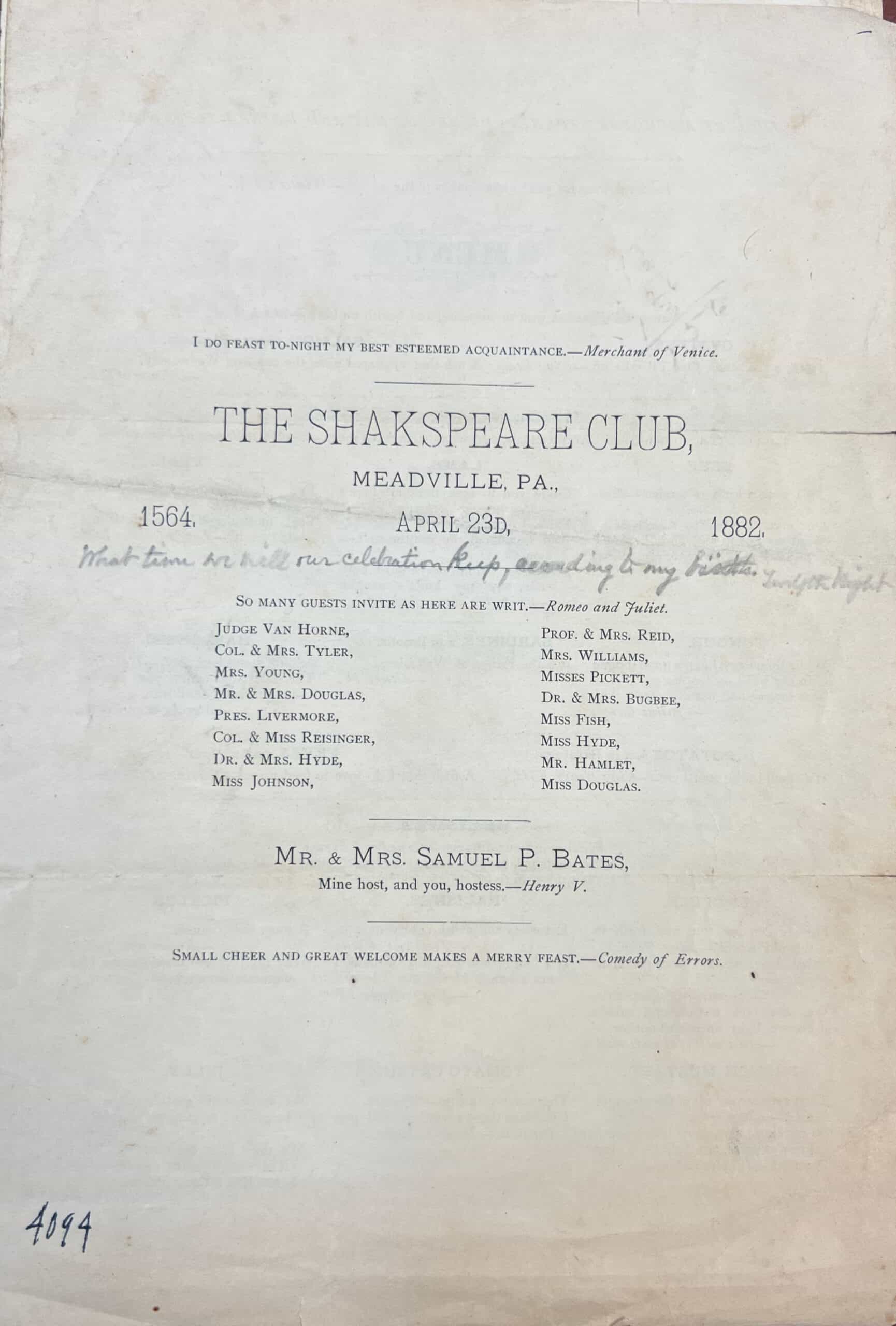
Shakespeare Club Menu page 1
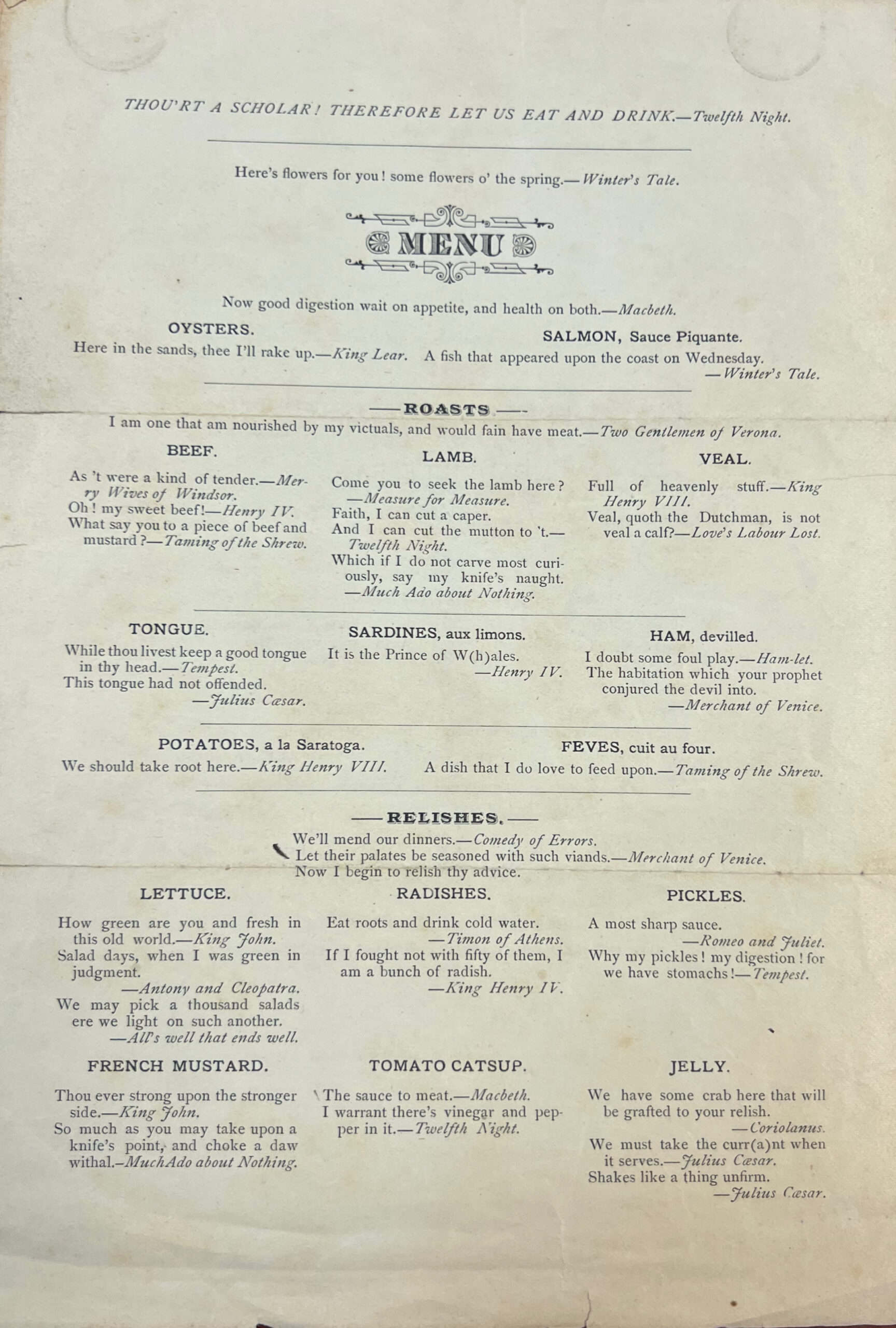
Shakespeare Club Menu page 2
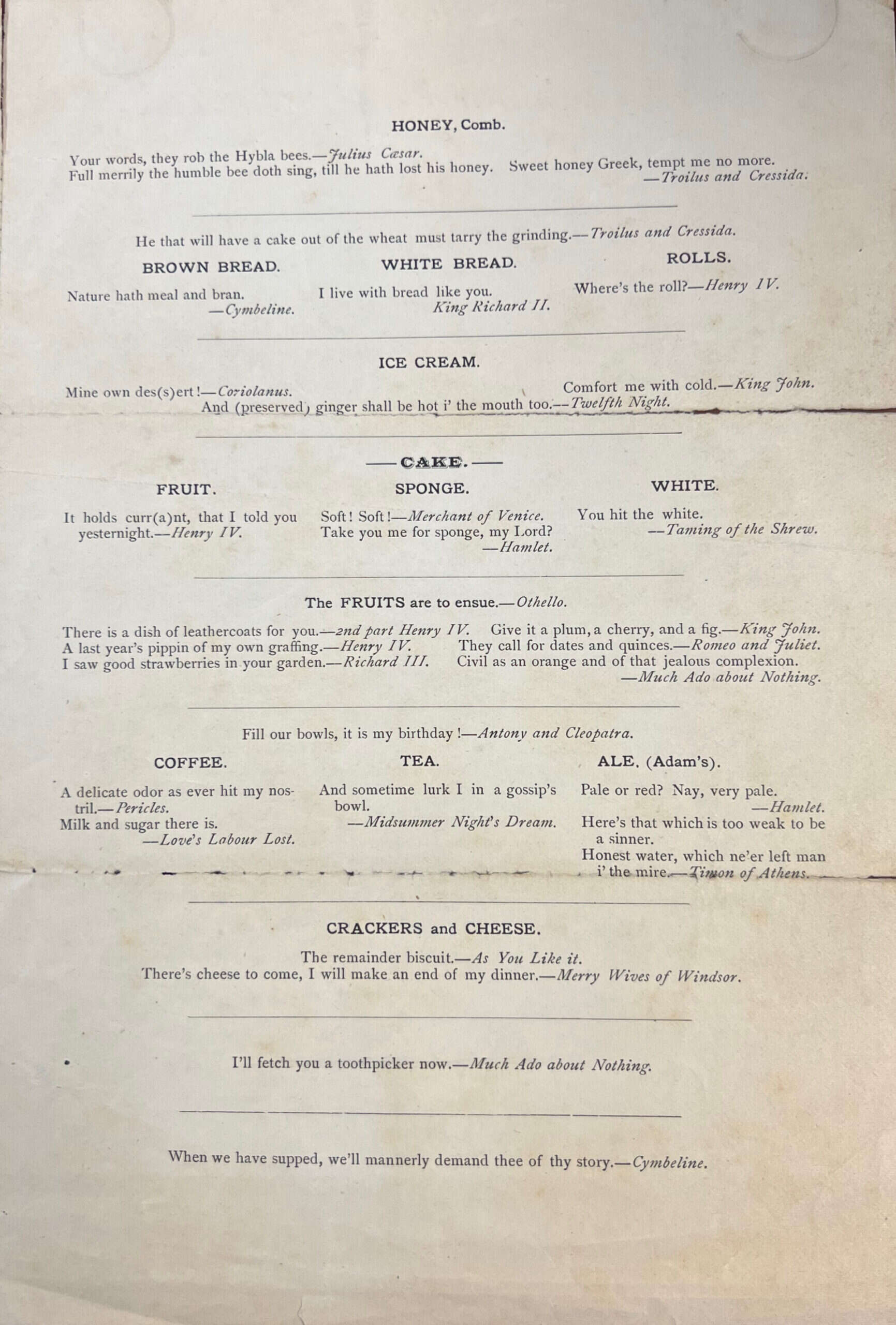
Shakespeare Club Menu page 3
I know little but this about the Shakespeare Club, but I do know that this type of quoting was done a great deal in Meadville at the time – Did Mr. and Mrs. Bates star this – was there a book available with quotations from Shakespeare for all types of food or occasions?
Music in Meadville
There is little about music in the Centennial and dates are hard to find – most of my information comes from the Sesquicentennial – an article by Mary Graham says that perhaps early settlers brought small instruments with them. There was a fine flute player named Augustus Colson; perhaps known even more because in 1824 Audubon used his office as his headquarters the short time he was in Meadville. Undoubtedly there were singing groups but it wasn’t until the 1850’s that music seems to burst out all over. I quote Miss Graham:
“During this time Meadville had a most amazing amount of musical talent. Many young people with unusually beautiful voices, leaders of ability and players of all kinds of orchestral instruments astonished nearby towns.”
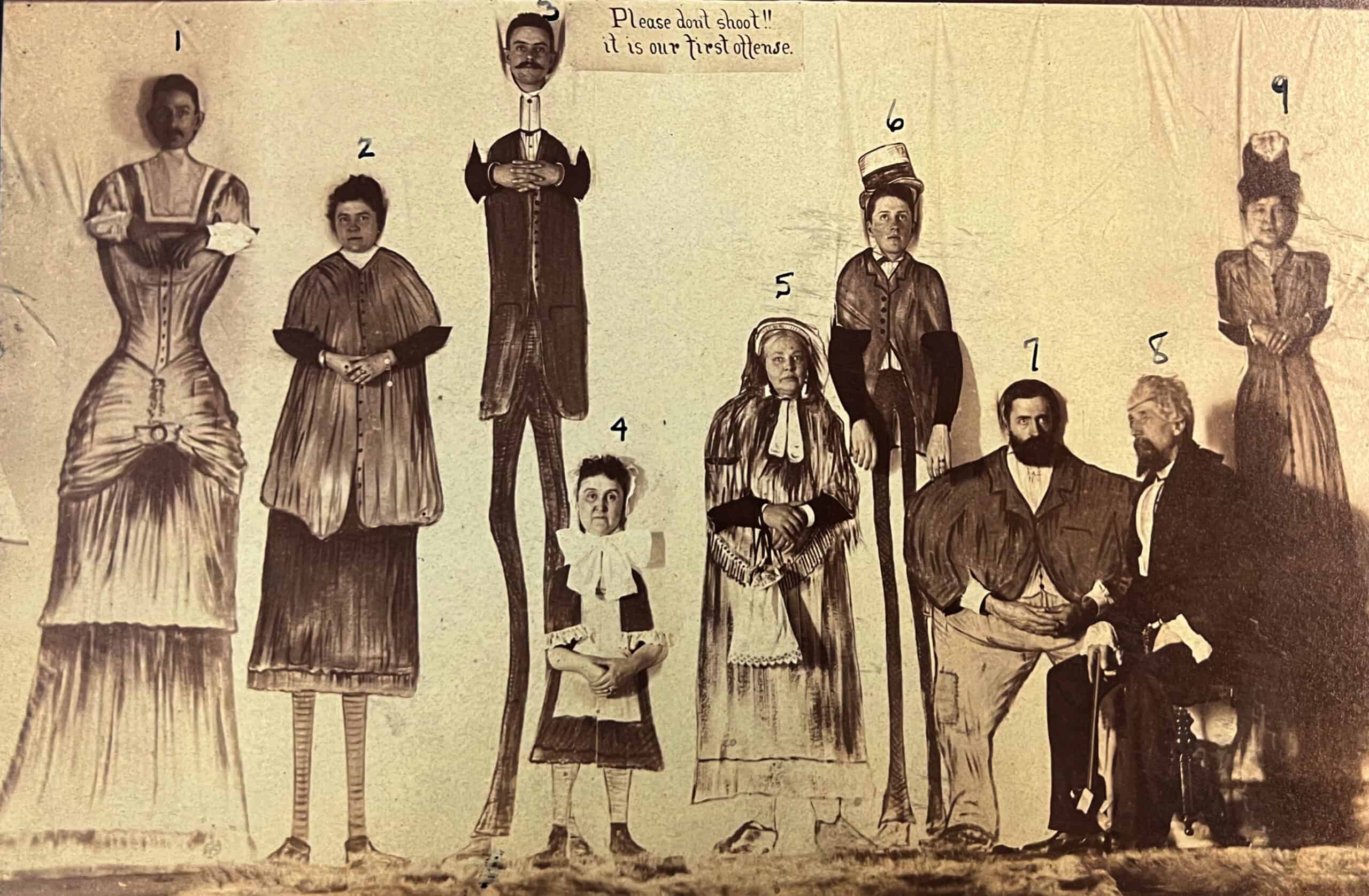
Concert/Tableaux circa 1889 – Either Library Hall or the Parish Building of the Episcopal Church.
1. Will Gray
2. Belle Tinker Dick
3. Harry Bartlett or Louis Boynton
4. Juvia Tinker Hull
5. Catherine Yeates Shippen
6. Henry Dick
7. John Dick
8. Hiram L. Richmond Jr., Conductor
9. Frances Adelaide McFadden Porter
Several times I cam across descriptions of this or that singer said by the newspaper account – to rival the singing of Jenny Lind.
Professor F. P. Boynton conducted the Northwestern Band and Orchestra. It became well known in this part of the State and often played in Chautauqua. He also directed the Philharmonic Society that produced operas using local talent. It was interesting to learn that in 1877 a normal school of music was held in the Court House during the summer with “Some of the leading instructors of New York.” The group attending put on 12 concerts.
The Tinker Sisters Bring Music to Meadville
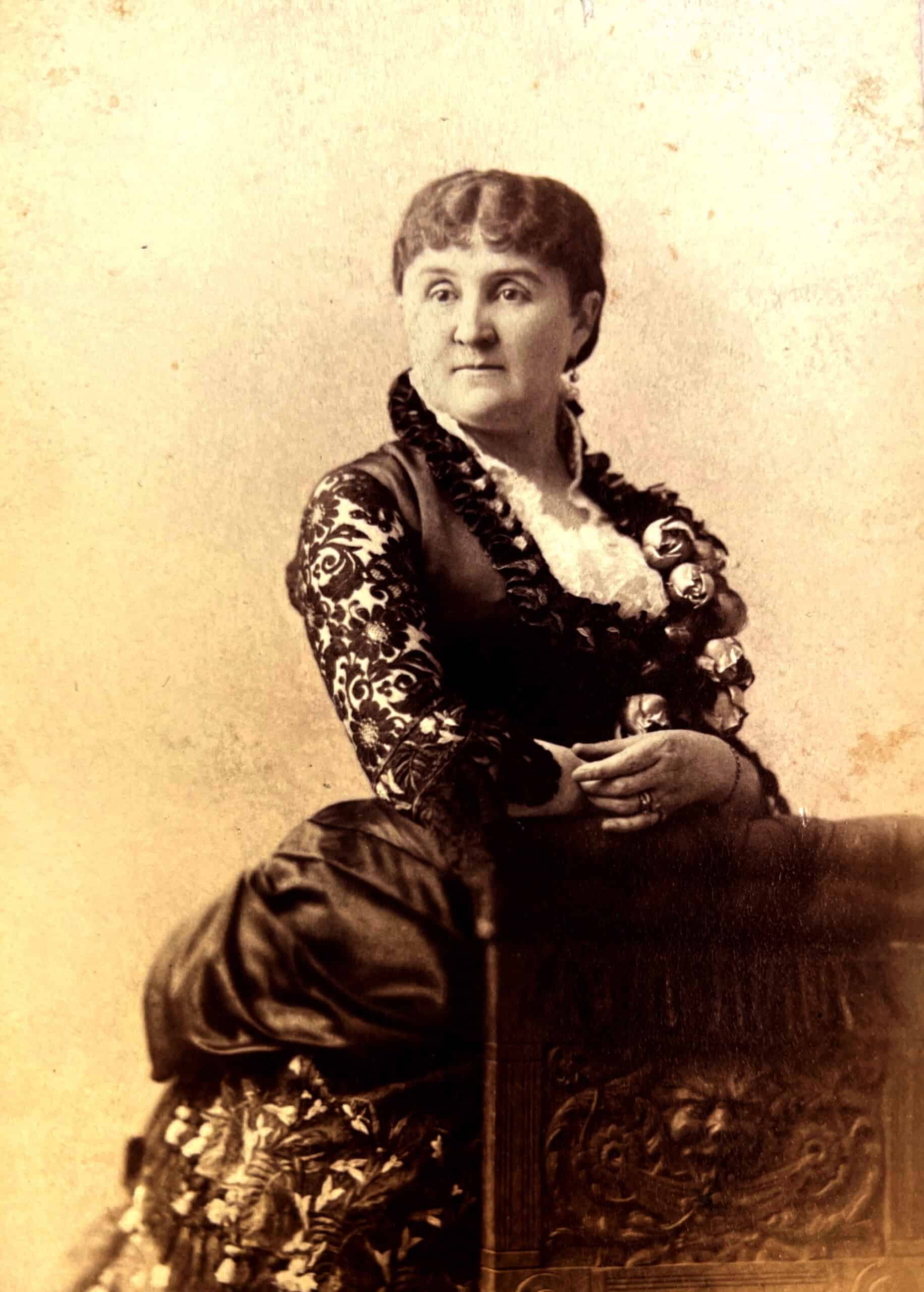
Juvia Tinker Hull, Founder of the Conservatory of Music
In 1886 the Conservatory of Music was started with Juvia Hull in charge. She had been one of the three Tinker sisters, who with their father, became nationally acclaimed, traveling from town to town giving concerts. Juvia was in great demand as a soloist, giving concerts in New York and Chicago. She had a beautiful voice and I am sure she, also, “rivaled Jenny Lind.” The Conservatory was soon affiliated with Allegheny College to the mutual advantage of both schools. The building was a brick one on the corner of Liberty and Chestnut and college credit was given students studying there and the faculty was listed in the college catalogue. Out of town students could stay at Hulings Hall.
Allegheny – in the Kaldron (yearbook) of 1893 lists a faculty of 13 (although two of these were tutors and one a lady principal of the Preparatory School). The Conservatory of Music had a faculty of ten in the yearbook and I was surprised to see that not only were many music courses listed, there were classes in French, German, woodcarving, physical culture and elocution. Juvia Hull was in charge of the school and taught voice. The year the Conservatory opened, (I found two dates – 1886 or 1887) there were 150 students. I am sure there were many more later.
In the 1893 yearbook Juvia Hull was the only woman whose picture appears – in fact not even President Wheeler or any Allegheny faculty are portrayed. The book states, “There is no happier existence than that of an active member of a Greek Letter Fraternity.” Bach Fraternity has a group picture. The sororities are listed without pictures. It mentions three literary clubs – neatly segregated – two for men and one for females.
There was no honor system as this doggerel makes perfectly clear –
“When a student sees a student
Cribbing on the sly
If a student tells a teacher
Then he ought to die.”
There is some interesting writing in the yearbook – some serious – and quite a bit of 1893 college humor. There is a long poem called “A Handy literal translation of the Iliad.”
“Come sing a song of the town of Troy
And the heroes who fought the battle.
How Achilles dressed in a stove pipe vest
Made Hector’s armor rattle.”
and it ends 23 verses later.
“And the thundering Jove in his palace above
Felt so good at the killing of Hector
That a banquet he set where the gods were all met
And got them all boozy on nectar!”
But to return to music – when we look at old programs or read accounts of different musicians we find that Meadville was not only endowed with talented people but that they were well trained in classical music.
There were numerous singing societies during the century – one, the Germanic singing society, was started in 1868 and in 1880 formed a second group called The Harmonie Singers that admitted as members only those who were able to speak German.
The Art of Almond George Richmond
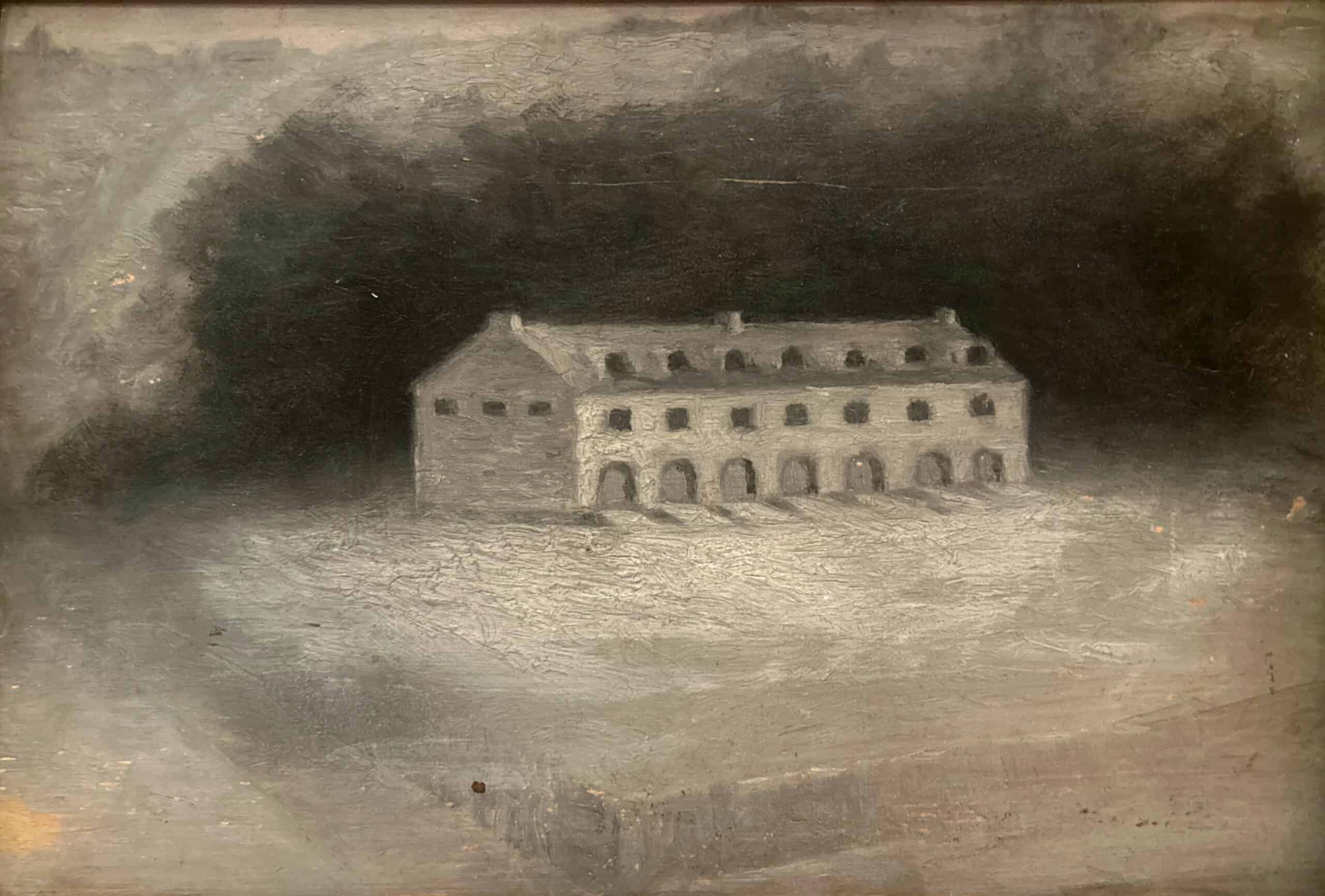
Arsenal, built at Randolph and North Main Streets. Painting by A.G. Richmond. Collection of the Crawford County Historical Society.
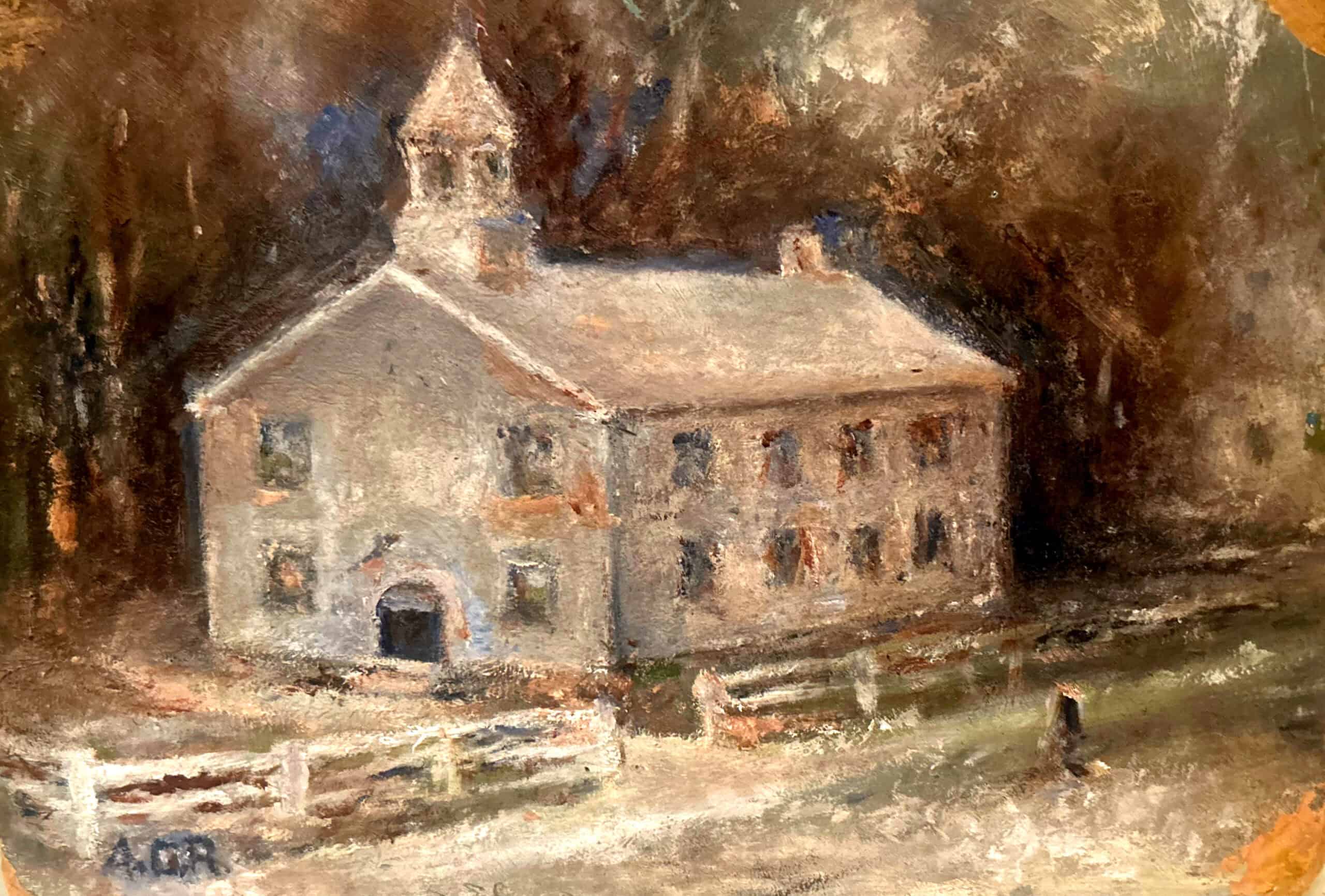
First Church, built in 1820. Painting by A.G. Richmond. Collection of the Crawford County Historical Society.
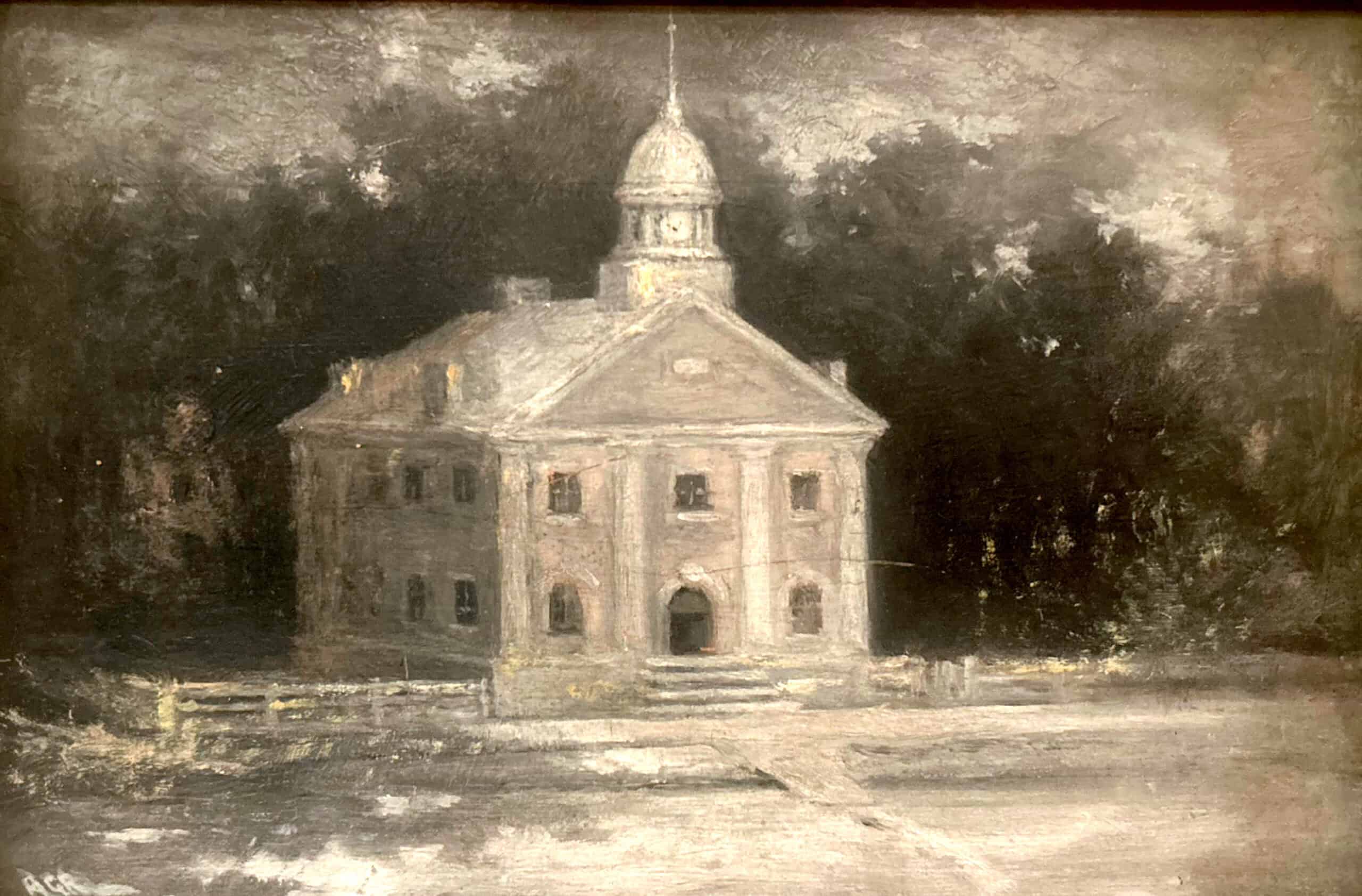
Second Courthouse completed in 1824. Painting by A.G. Richmond. Collection of the Crawford County Historical Society.
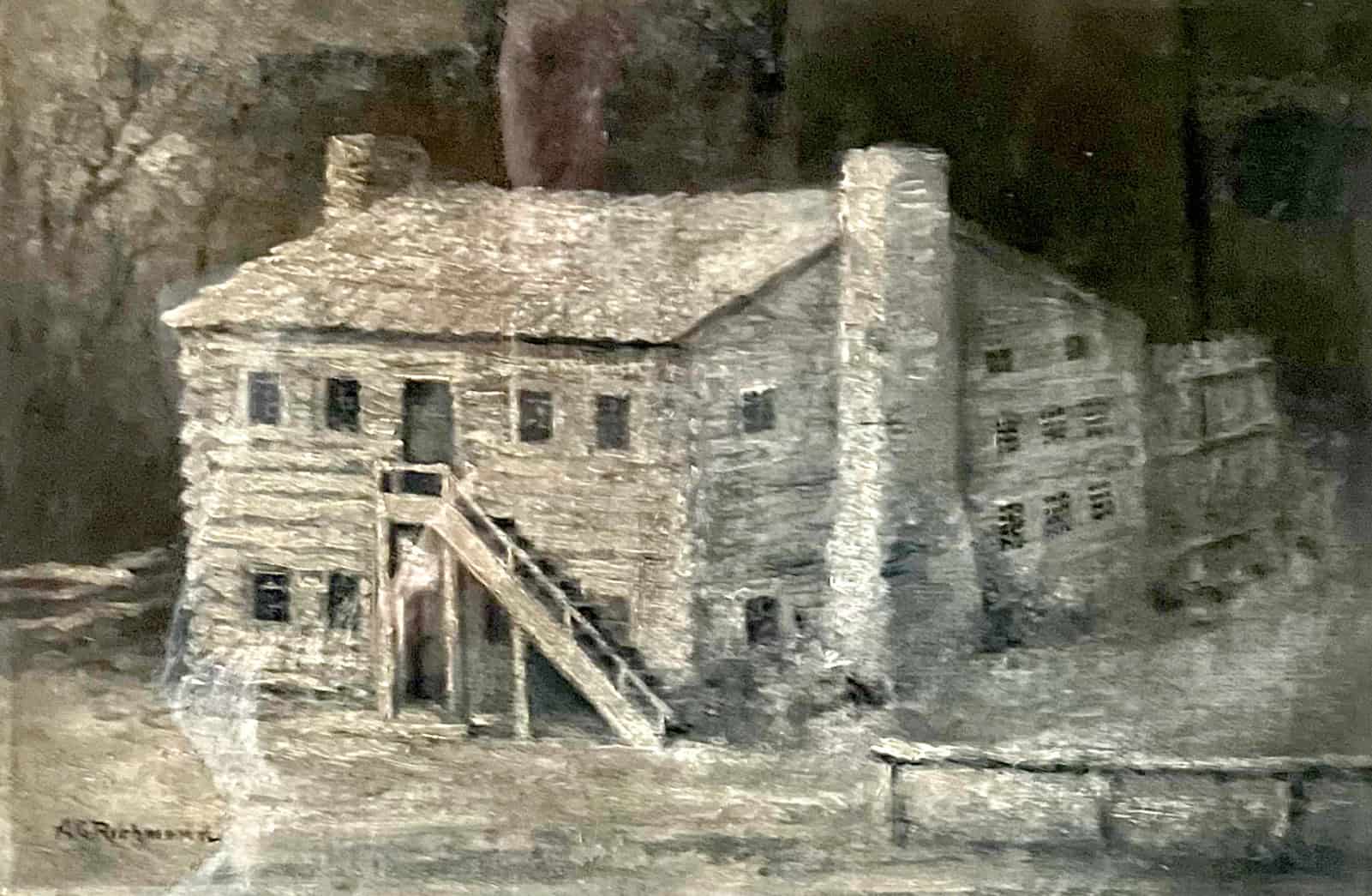
First courthouse building constructed in 1805 by William Dick. Painting by A.G. Richmond. Collection of Allegheny College.
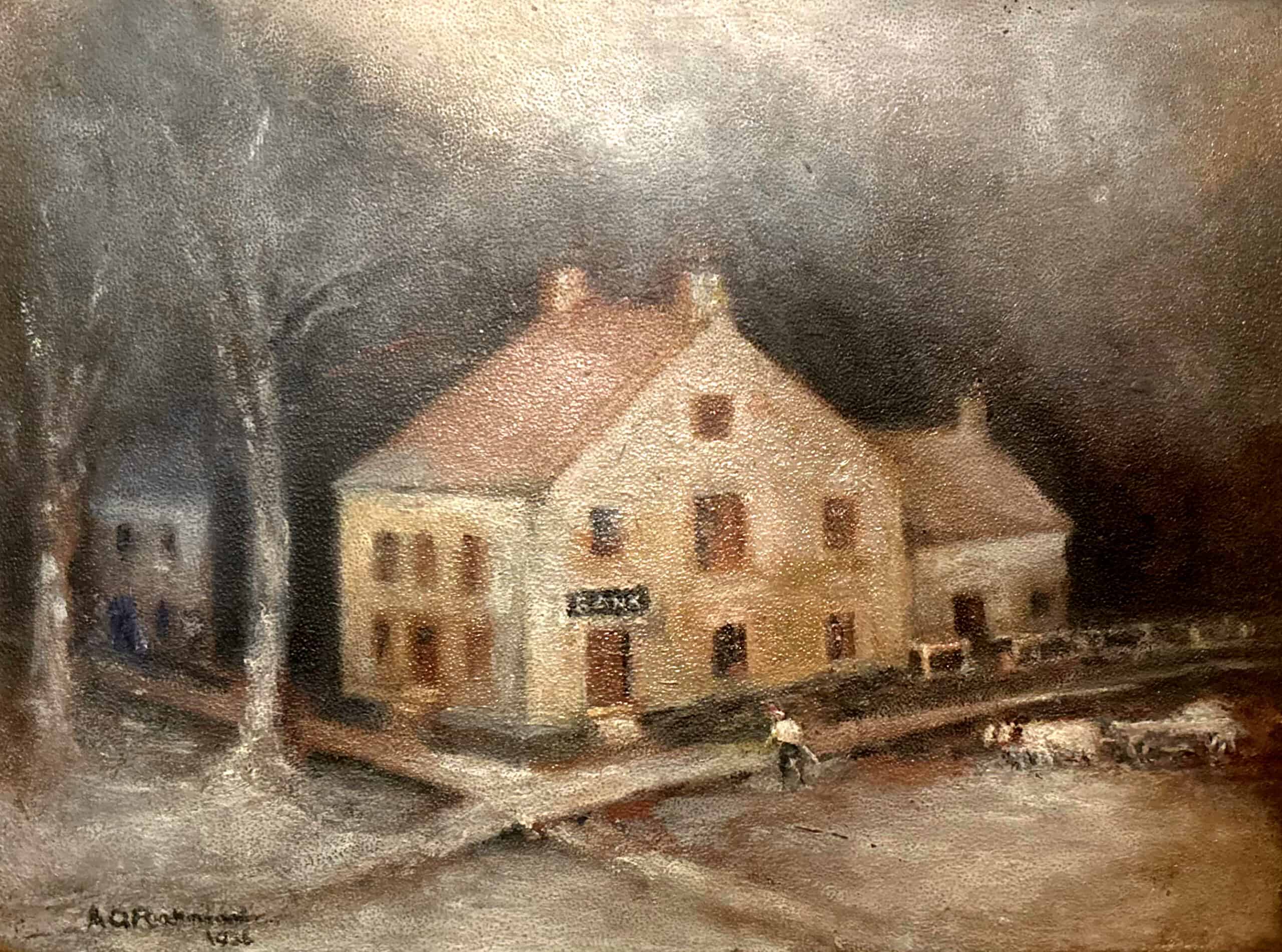
North Western Bank. Painting by A.G. Richmond. Collection of the Crawford County Historical Society.
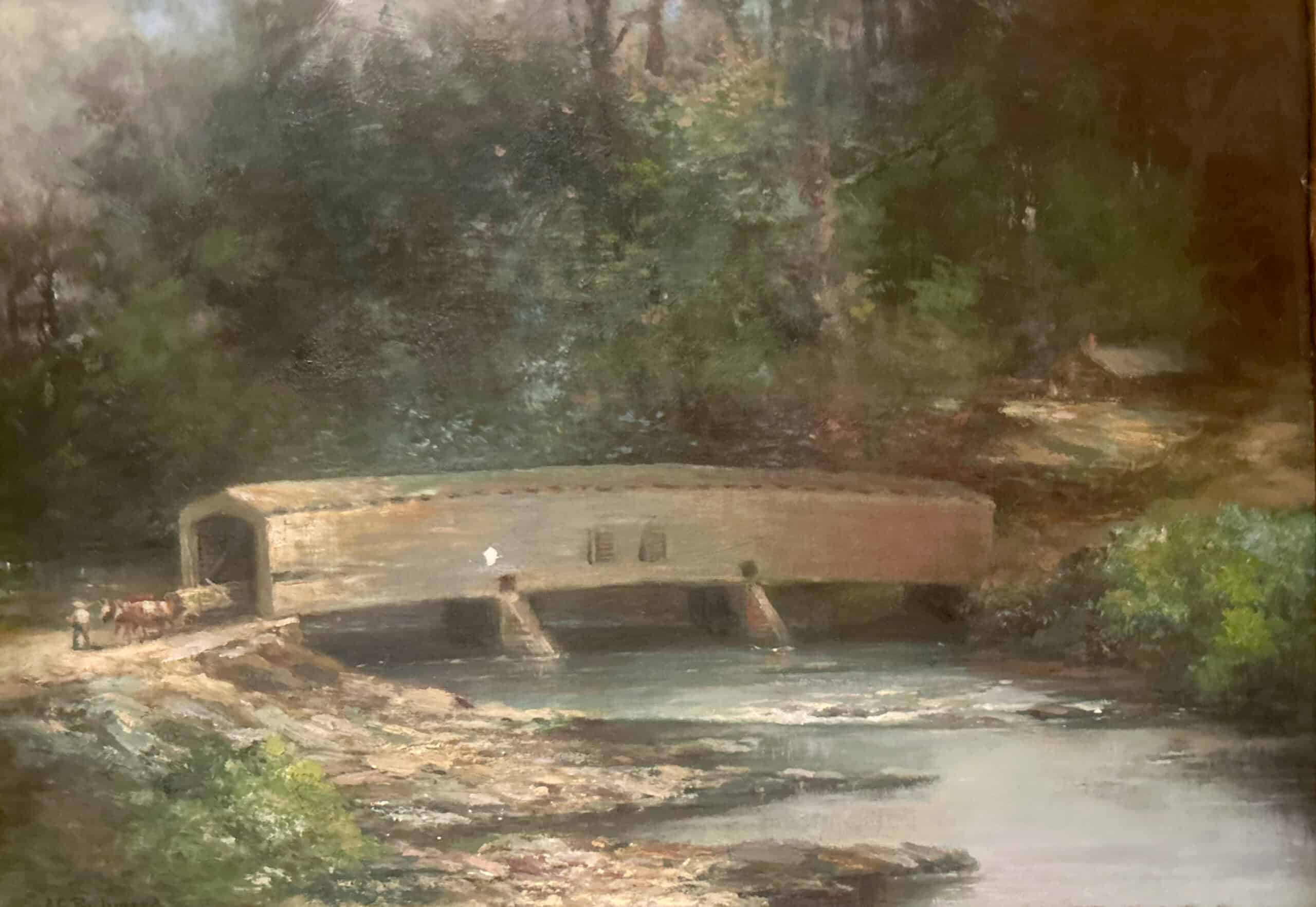
Mercer Turnpike Bridge across French Creek, built by Dr. Thomas Kennedy in 1810. Carried away by flood in 1838. Painting by A.G. Richmond. Collection of the Crawford County Historical Society.
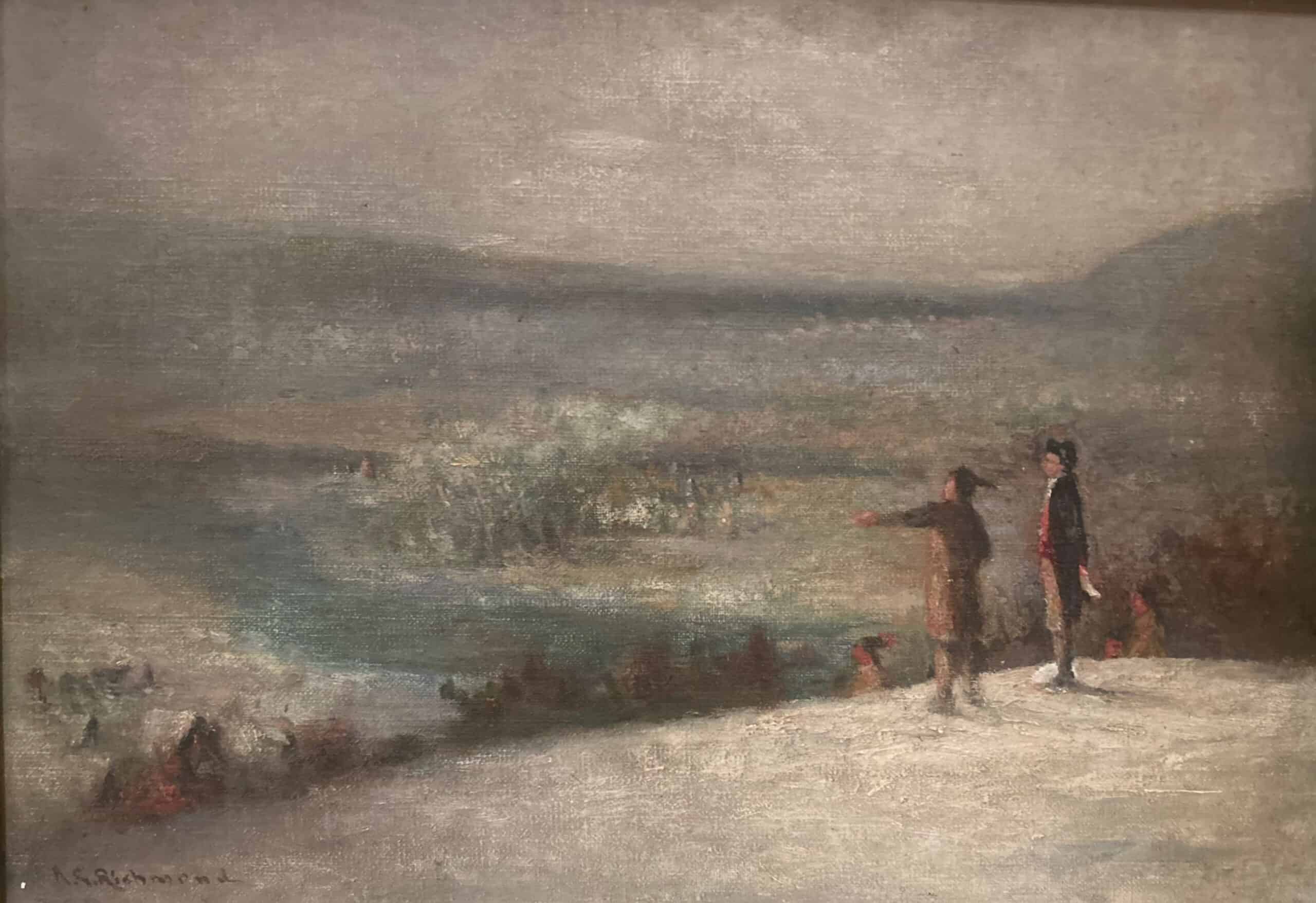
George Washington and guide Christopher Gist on December 9, 1753 looking over islands in French Creek. Painting by A.G. Richmond. Collection of the Crawford County Historical Society.
Since time does not permit dealing with other arts as full as they should be given how prolific the art scene was in Meadville, I will discuss only the painting of Almond George Richmond. I am interested in him first, because he and my grandfather were college friends and graduated from Allegheny in the class of 1870. The second reason is that he was a fine painter. When he left Allegheny he got his law degree and for some time was City Soliciter. There was a man named Lorandi who taught painting and Mr. Richmond, while young, studied with him, but his skill soon out-stripped his teacher’s, as he was far from being a mere amateur. Painting was something he enjoyed all his life.
I quote from the Tribune Republican,
“In addition to his legal activities Mr. Richmond was possessed with the eye, imagination and hand of an artist. For more than a half a century he has provoked both the mirth and appreciation of his friends by cartoons of local personages, or oil pointings of charm and challenge. One of these, Farnsworth’s Death Charge adorns the wall of the Soldiers Memorial Building in Pittsburgh.”
We have some of his pictures here from the Historical Society. His daughter, Mrs. (Gail Richmond) Lyndon, has a great many – 5 he said he painted after he retired from his law practice, and his painting gave him great joy. His pictures are for the most part of the local scene.
Meadville Needs a Library…and a Historical Society…and an Art Society!
The desire to have a library in a community is an indication of cultural climate. This quote from the Centennial shows how early it was held by Meadville,
“As evidence of the taste and culture of the citizens of the village in 1812 was the organization of the Meadville library. It contained 150 volunes of standar worker history, blography and travel, and not a single work of fiction. The association of good reading until the donation to Allegheny College enlarged the literary field.” (The first library was in John Reynolds’s office.)
July 1868 the City Library of Meadville was formed. The Constitution stated that “any person may become a member by contributing one volume to the library and paying one dollar annually.” Influential citizens had organized an historical society – others an art society, and by 1879 The Meadville, Library, Art and Historical Society was incorporated. Stock was sold, two-hundred shares for 25 dollars each. The Huidekoper woolen mill (for some time used as a meeting place and called Central Hall) was purchased by the Corporation. By now there was a library of 2,936 volumes. The members of the Board were elected from shareholders. This method continued up into the 1960’s – that to qualify one must own, inherit or have passed on to you, a share.
The idea of libraries being free to the public was rather new to Meadville citizens, but I did read that one or two members of the Corporation were hoping that this could be the case with Meadville, when the Library was still young.
By 1897 there were 6,300 books in the library; and in 1898 a private annual subscription was set up so that use of the library could be free to all Meadville citizens.
When the Historical Society had joined the corporation, it became The Crawford County Historical Society. It sponsored the Centennial celebration of 1888 and had its quarters in their building. The Art Association was also there – its stated purpose was to be for the collection and preservation of works of art. Samuel P. Bates was president. It was that year that Mrs. Cortazzo – a Huidekoper relative, was in Rome, and the Meadville Library, Art and Historical Association sent her $25 with which she was to buy photographs of the best art works to be used at art meetings. There were many gifts to the Association – among them a bust of Shakespeare from the Shakespeare Society, a large cast of the Venus de Milo from the C1ty’s Teachers, a cast of the head of Moses by Michaelangelo from “Hebrew” Friends – plus loans of paintings and photographs. There were 54 members and a waiting list of proposed candidates. It lasted until the mid 1930’s.
In Meadville in the 19th Century, there were no Federal, State or local funds available – no outside large Foundations or endowments for for libraries, hospitals, or schools. So if there was resentment at seeing the names of the prominent citizens recurring again and again on all boards and committees in town, we have to realize that there was little upward mobility. Masterpiece Theatre’s play Upstairs Downstairs gives a true picture of this fact especially in the late part of the 19th and early 20th Century. It was Huidekoper, Reynolds, Bates, Richmond – to name a few – who in the early years of Meadville had been the ones who set the cultural tone of Meadville society – but more than that they had a sincere interest in art and education, not for just their own families, but for the community. They made libraries, hospitals, and schools possible, and as time went on these people and their descendents continued to hold prominent places in all community affairs.
This ends the second of two parts of “The Cultural Climate of Meadville: From 1800 – 1900.”

References
This essay was written from the files and newspaper collection of the Crawford County Historical Society in 1974.
About the Author
Carol M. Ross was a member of the Women’s Literary Society of Meadville and presented this paper on March 1, 1974 to its members. It is being split into two parts for publication length. Any commentary and views made within the article are hers alone.
Sign Up for Our Newsletter
Get the latest Crawford County Historical Society news and information delivered right to your inbox.
"*" indicates required fields