
Back to Articles
The Cultural Climate of Meadville: From 1800-1900 is an article written in 1974 by Mrs. Julian (Carol) Ross for the members of the Meadville Women’s Literary Union. She researched theater, art, music, and other categories of cultural endeavors throughout the 19th century in Meadville in hopes to get a timeline and understanding of social history in our area. We have split it into two parts due to its length. Part one covers everything from Meadville’s founding to theaters, minstrel shows, musicals, and more!
“Broad Views and Great Enterprise” From the Start
On page three of the Centennial edition of the Tribune Republican, William Reynolds said of the year 1800, “Our village, even at that early date numbered among its citizens many men of broad views, great enterprise and much above average in intelligence and education.”
During the first twelve years of Meadville’s history there is little to discuss as far as the arts are concerned, for to develop them there must be some leisure from the struggle to exist – and a feeling of security from attack. But after 1800, the new community developed rapidly, building churches and schools, having a newspaper, and forming groups to pursue various intellectual interests.
Huidekoper and Alden: A Case of Dueling Ideologies
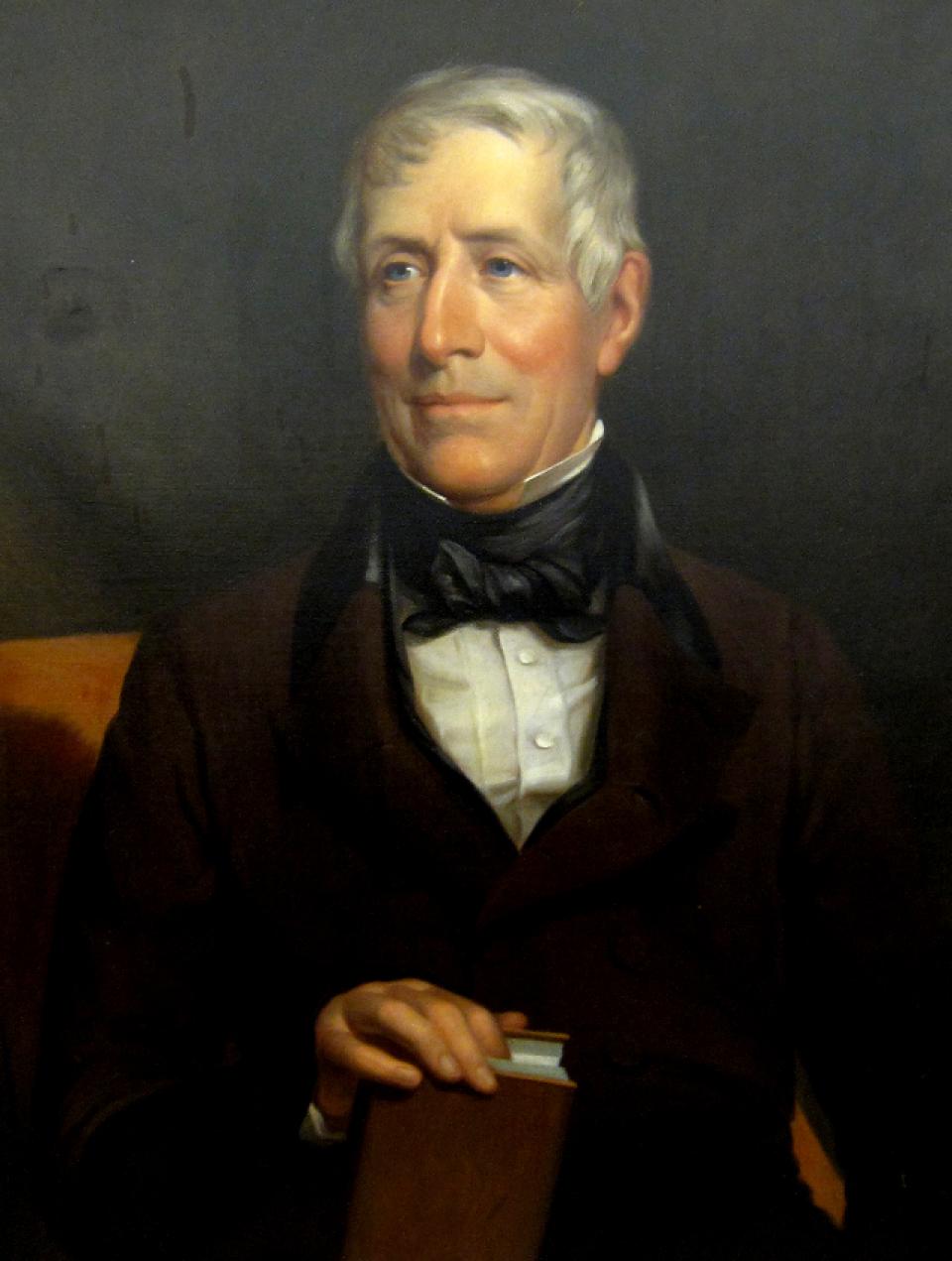
Harm Jan Huidekoper from a painting by John Neagle, Collection of the Crawford County Historical Society
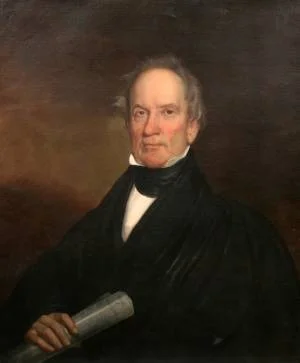
Timothy Alden
Two men, both well educated but with differing philosophies, were especially responsible for Meadville’s cultural developments Harm Jan Huidekoper, who first visited here in 1802 as an agent of the Holland Land Co. and returned three years later to open an office for the company and remained as a citizen, and Timothy Alden, arriving in 1815 to start a college in the wilderness.
Huidekoper was well educated, with an European background, and held a liberal outlook on life. Timothy Alden came from New England and was a Presbyterian with very conservative views, more rigid than one would expect from his Harvard education.
Because of Alden, a school was started that became Allegheny College, built on one hill, and because of Huidekoper, a Theological seminary was built on another hill several years later. Because of Alden, Bentley Hall was built in 1829, and because of Huidekoper, a Unitarian Church was built in 1836. Both buildings were fine examples of neoclassical architecture.
The differing philosophies of the two men did not exist in a vacuum, for each attracted others to his way of thinking. Today, looking back on their ideologies, it is surprising to find that a man as conservative as Timothy Alden, could be the father of a liberal arts college, and Huidekoper’s Unitarianism, so radical to the early 19th century, held beliefs much like those held by the more liberal Protestant churches of today.
The first church to be built in Meadville was the Presbyterian, and Timothy Alden frequently preached there. Huidekoper, his family and friends were allowed to hold their meetings in the church. For a time the two men were friendly combatants, enjoying theological debates, but finally Alden and his followers decided that Calvinism and Unitarianism could not or should not mix, and the church was closed to the Huidekopers and their group.
These two ways of looking at religion and often at politics, still exist today, yet all through the years they have been able to meet to promote progress in Meadville whether it be social or cultural.
One example of cultural climate in the early days of the community was the life at Pomona Hall. There is a book written by Nina and Francis Tiffany, published in 1904, that gives a delightful description of the Huidekoper family. Pomona may not have been quite the Arcadian paradise they describe, but much of it was true. There seemed to be a happy, harmonious family life in beautiful surroundings. All of them were intellectually interested in and capable of enjoying books, music, nature and each other. It was a house constantly filled with guests, many traveling through Meadville.
The land around Pomona was productive as well as attractive. Mr. Huidekoper, by large urban standards, would not have been considered wealthy; by Meadville standards he was well off indeed.
Tutors from New England came to teach the children and to live as members of the family until they returned to New England, where some of them became well known as ministers or men of letters.
To quote the Tiffanys: “It was largely Mr. Dwight and William Henry Channing (tutors) who brought to Pomona a light suggestion of the dawning spirit of the New England Renaissance – the awakening to joy in life, to relish in literature and art, and to the desire to experiment in new modes of living, to create fresh ideals and to build religion and society anew.” Some of this could not help but spill over into the Meadville community.
One other quote – this one from a letter written by Frederick Huidekoper to a niece or nephew – he speaks of a time in the 1830’s, “While Mr. Dwight was with us, William Channing filled for some months our pulpit and on one occasion the two, with my brother Edgar and myself visited your grandfather’s vacant field on the opposite side of the creek. There we seated ourselves on stumps and read Shakespeare for the benefit of our lungs. A congregation of cows collected and your Uncle Edgar with Mr. Channing took two umbrellas and ran toward them, opening and shutting the umbrellas. The cows took off down the hillside in fright and the readers returned to their positions. Within ten minutes the herd of fifteen or twenty animals returned. This time they came cautiously, each cow protruding its head warily through the bushes. The whole side of the hill presented a row of cows listening to Shakespeare,” Perhaps this could be called the first production of Shakespeare in French Creek Valley: Four exuberant Unitarians performing for an audience of cows!
Early Theatre in Meadville
Transitions are hard to make so this quote from Frederick Huidekoper is as good as any time to back-track to the earliest forms of entertainment in Meadville. In 1778, Pennsylvania passed a law declaring all theatrical performances to be illegal. This was repeated eleven years later. There is a doctoral thesis written by Bernard Engle in 1968, “The Meadville Stage from 1800 to 1899,” and I have relied on this for much of my information of theater in this period.
It is probably true that quite early in Meadville, all plays or skits were given in inns and taverns, and there may have been concerts and lectures, but if so, we do not have much written about them. We do know that a lion and his trainer came to town – also at one time, an elephant and his trainer. There was a ventriloquist and a man who traveled about giving Shakespearean readings. And even this early, traveling circuses came to this part of Pennsylvania.
On February 24, 1824, the following notice appeared in the Crawford Messenger, “A meeting of the young men of the Borough is requested this evening at the Inn of Mr. John Bennett for the purpose of selecting a play for performance, the proceeds of which is to be added to the Greek fund.” At a time when the population of Meadville was 882 and when news from Europe took 71 to 85 days to reach Meadville, it is interesting to know that Meadville citizens were very much aware of the struggle the Greeks were having against the Turks. They may not have known anything of Lord Byron – of his death later in Greece, but with their feelings about their own war for independence which was not too long in the past, and their own freedom relatively untarnished, their sympathies for the Greeks were aroused and they were raising money to help them.
The meeting at Bennet’s Inn started a theater group that by early 1825 became The Thespians. They drew up an elaborate constitution, one article of which stated that members should pledge themselves to accept parts assigned by a committee. James Perkins signed the pledge but on the condition that he not be given female parts to play. William Shattuck, a young congressman, however, was pleased to play, “Lovely Ladies” in their early shows.
Their first play was Who Wants a Guinea, followed by a short farce, The Pedler. It was usual then to have some short and farcical play after the main play of the evening. Only one other play was given by the Thespians, John Bull. In 1827 a notice in the Crawford Messenger calling for a meeting of the Thespians – a meeting that possibly never took place; and that is all I know about the first little theater in Meadville.
In August 1833, the Borough of Meadville passed an ordinance that said, “that no person or persons shall be permitted to perform or exhibit any play, show, spectacle of theatrical entertainment in the Borough of Meadville unless it be of decent and of moral tendency.” This was signed by the Burgess, John Reynolds (J.R. Senior, father of William Reynolds).
One wonders what caused it to be drawn up, if it was withdrawn later, or perhaps it just faded away.
Uncle Tom’s Cabin first came to Meadville in 1854. The company brought a mammoth tent said to seat 5,000 persons. Since Meadville had a population of 1,500, it could not have been a very full house even with people attending from surrounding townships. It was an enormous success. The play was to rival in popularity Abie’s Irish Rose of the 20th Century. The novel of Uncle Ton’s Cabin was popular abroad, in one case at least with a strange Interpretation – “Uncle Tom’s Cabin has received the approval of the Pope as an ultra Roman Catholic novel. An ingenious but not very probable alteration has been made in the Italian version, by which Uncle Tom is represented as receiving punishment and death on account of his adherence to the dogma of the Immaculate Conception.” The play returned to Meadville 38 times in 44 years. Finally to the exasperation of the local paper and theater managers, in 1885 the paper said, “At last account the managers of the theater were endeavoring to negotiate with the faculty of Allegheny College for their cannon (could this have been the old Phi Gam cannon?) with which to slaughter the advance agent should he alight in our midst.”
In 1893 the Tribune Republican wrote “If the original Simon Legree had been at the Academy of Music last evening, he would doubtless have killed more than Uncle Tom and by so doing he would present the only feature of the entertainment.”
One prominent citizen was said to never miss the play and always sobbed loudly over little Eva’s death. But to go back again several years as I frequently do in this paper – 0il and water do not mix, but oil, railroads and traveling theatrical companies certainly did in this area. October 1859 the Crawford Journal reported that the Drake Well had struck o1l. Titusville and surrounding villages, almost over night became boom towns, but in Meadville it was the coming of the railroad that brought prosperity, many hotels, theater and strangers in town.
The Train is Coming…and Culture with it
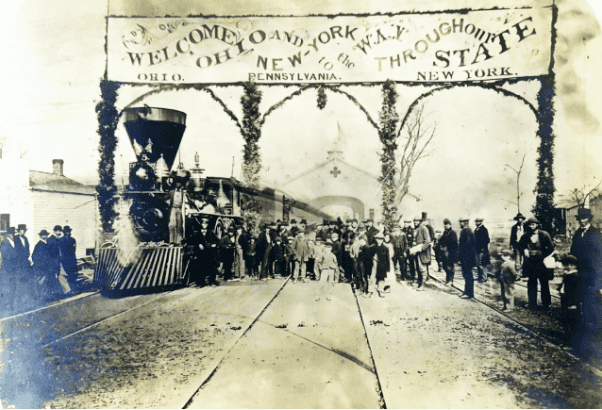
The First Train arriving in Meadville, October 1862.
The tracks were laid into Meadville in 1862. In 1863 the first train pulled in to town, and this was the beginning of cultural shock along with cultural advantages. A huge station was built said to cover more land than any other building outside New York City. Attached to it was the McHenry House that has been described in another paper. The dining room was enormous and elaborate, two stories high with stained glass windows. The bill of fare was also fantastic. It would contain 4 kinds of cold meat, 6 varieties of game, 8 desserts, and I am tempted to add, “a partridge in a pear tree.”
The hotel was built for and by the Atlantic and Great Western Railroad – with its connecting branches of tracks it could serve a large area and so became the center of activity for Northwestern Pennsylvania, and it caused a boom for Meadville merchants. Theater companies came in incredible numbers and were met with delight and sometimes disapproval by local citizens. For acting companies and agents it was pleasant to stay at the McHenry House, from which they could go on to surrounding towns to perform.
The Cleveland Dramatic Company was the first to come, and it stayed at the McHenry House for two weeks. At the time, Meadville had no very large halls. Museum Hall and Central Hall were used. It is evidence of how welcome theater was to Meadville that the Opera House was constructed in 1869. The top three stories of the Cullum Block were converted into a lavish Opera House, seating 1200 people, and until it burned down in 1884, brought every kind of theater and music one could imagine, – farce, westerns, Shakespearean plays. (Othello, given during the opening week of the Opera House, was well attended.) The music was as mixed – good opera, bad musicals, and an occasional fine orchestra.
Two different times, the Mendelsshohn quartet came from Boston. There were several operas through the years – Gilbert and Sullivan began coming in the 1880’s. After the Mikado was here, the young women of Meadville began carrying Japanese parasols. A local cantata with 40 singers put on an operetta, The Hay Makers, conducted by a Mr. A. I. Boynton, owner of the only music store in town. I am not going to list the many fine actors and opera singers who came. to Meadville because another paper deals with “Famous Visitors,” but the number was amazing – some were to achieve fame later – others were already nationally known.
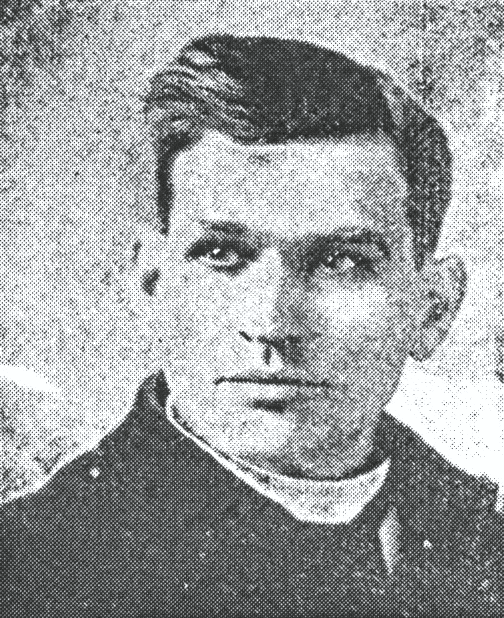
Sam T. Jack, pioneer of the African-American vaudeville industry in the US with his Creole Burlesque Show. On December 13, 1879 the Meadville Evening Republican reported, “Mr. Sam Jack, the manager, who has given Meadville and the towns of the region so many entertainments of the highest order this season, deserves the most liberal patronage of the public … for his enterprise and good judgment as a caterer to the best classes of theatre goers.”
“Trash,” minstrel shows, burlesque, soap opera-type plays, crude comedy, proliferated as the century went into the 80’s and 90’s.
Theater-goers were harassed by rowdies who sat in the gallery and balcony and took delight in putting their feet on the railings so their muddy or snowy boots could drip on the well-dressed people below. They spit tobacco juice and expressed approval or disapproval in no uncertain terms. The opera house had burned down in January 1884, and plays were held in Museum Hall. At one performance there to emphasize their displeasure, they broke up seats, chased the orchestra and “actors” off the stage and out of the building. The report in the paper put “actors” in quotes so perhaps they were pretty bad! Titusville and Meadville, never to be outdone by each other, took to the paper with comparisons, with Titusville boasting that their rowdies were much worse.
Since fewer plays were coming to Meadville because of lack of adequate space, a Mr. Andrews, manager of the Commercial Hotel, started a little theater of local people, calling it the Bijou Players. Their plays were held in the Hotel.
It shows how dependent on play-going Meadville had become, that within a year of the Opera House fire, the building of the Academy of Music was begun. It opened December 1886. Besides – managers and merchants in town missed the money they had been making and were eager to welcome back the large companies.
At one time agents and managers of traveling companies had promoted the idea that presidential terms should be for 6 years – or better still – 8 – instead of 4, because the play-goers were distracted by presidential campaigns and this cut into their profits.
The Academy of Music
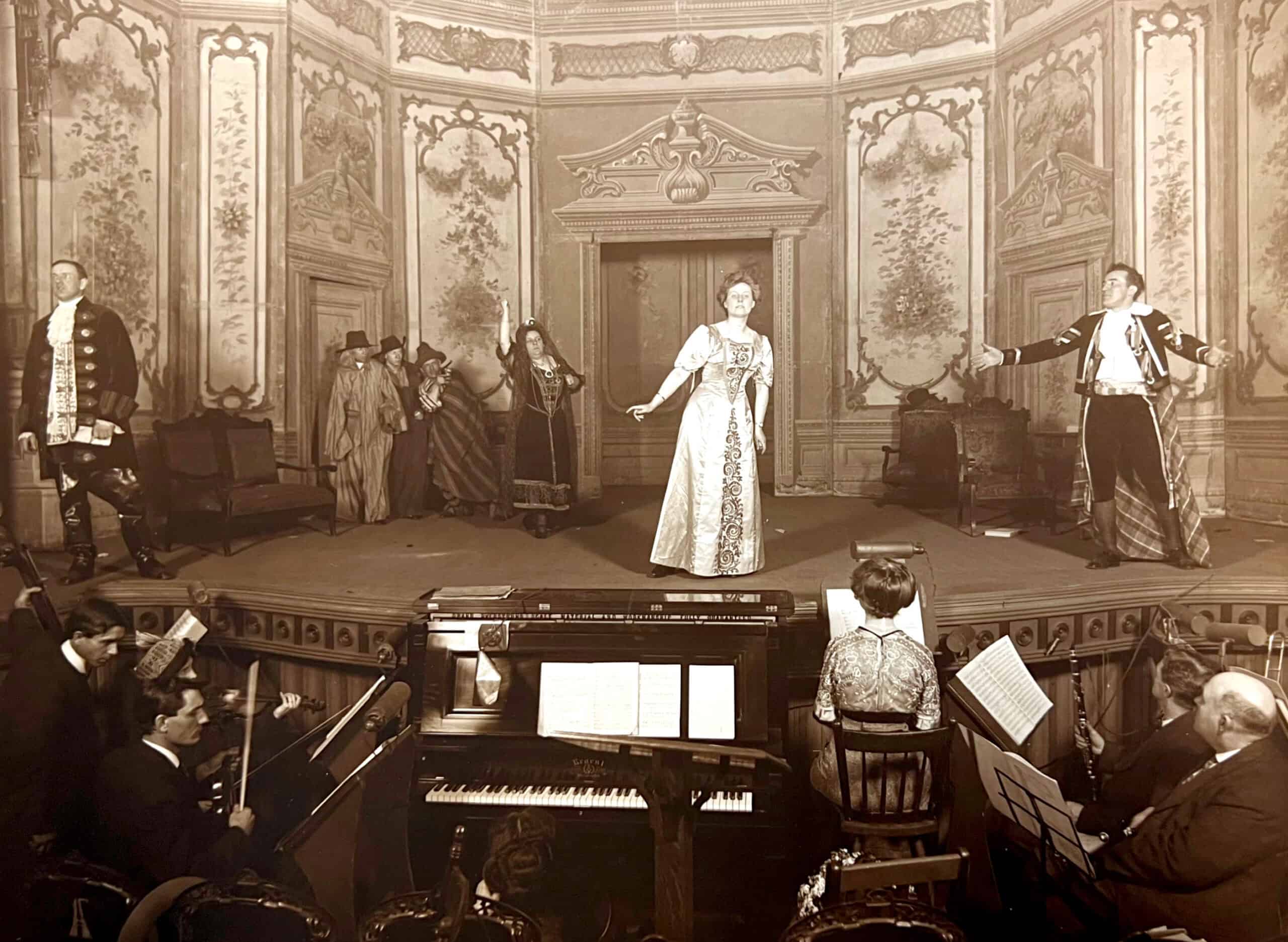
Stage production at the Academy of Music (known now as the Academy Theatre), Meadville, Pennsylvania. Collection of the Crawford County Historical Society
The Academy of Music was much as it is now except for a gallery as well as a balcony – and eight boxes. It was for the times a very well equipped theater. The opening play on December 15, 1884 was Francesca da Rimini. In 1888, 56 companies came to town. The old standbys – Uncle Tom’s Cabin, East Lynne, Two Orphans, still came. But there were many that were stupid and shoddy, and on the whole, that was what the audiences wanted. Evangeline or Passions Slave, was such a hit there was a special train to bring 60 people from Cochranton. Plays with names like Dad’s Girl, FireFly, Velvet and Rags, drew crowds. When the Opera House had opened in 1869, Othello had been one of the opening plays and the audiences were pleased with it. But later a fine performance of Twelfth Night attracted only a few people. A Winter’s Tale was given to a small audience. The paper complained that only educated people bothered to attend Shakeperian plays, and they were embarrassed by so many uncultivated people who stayed away.
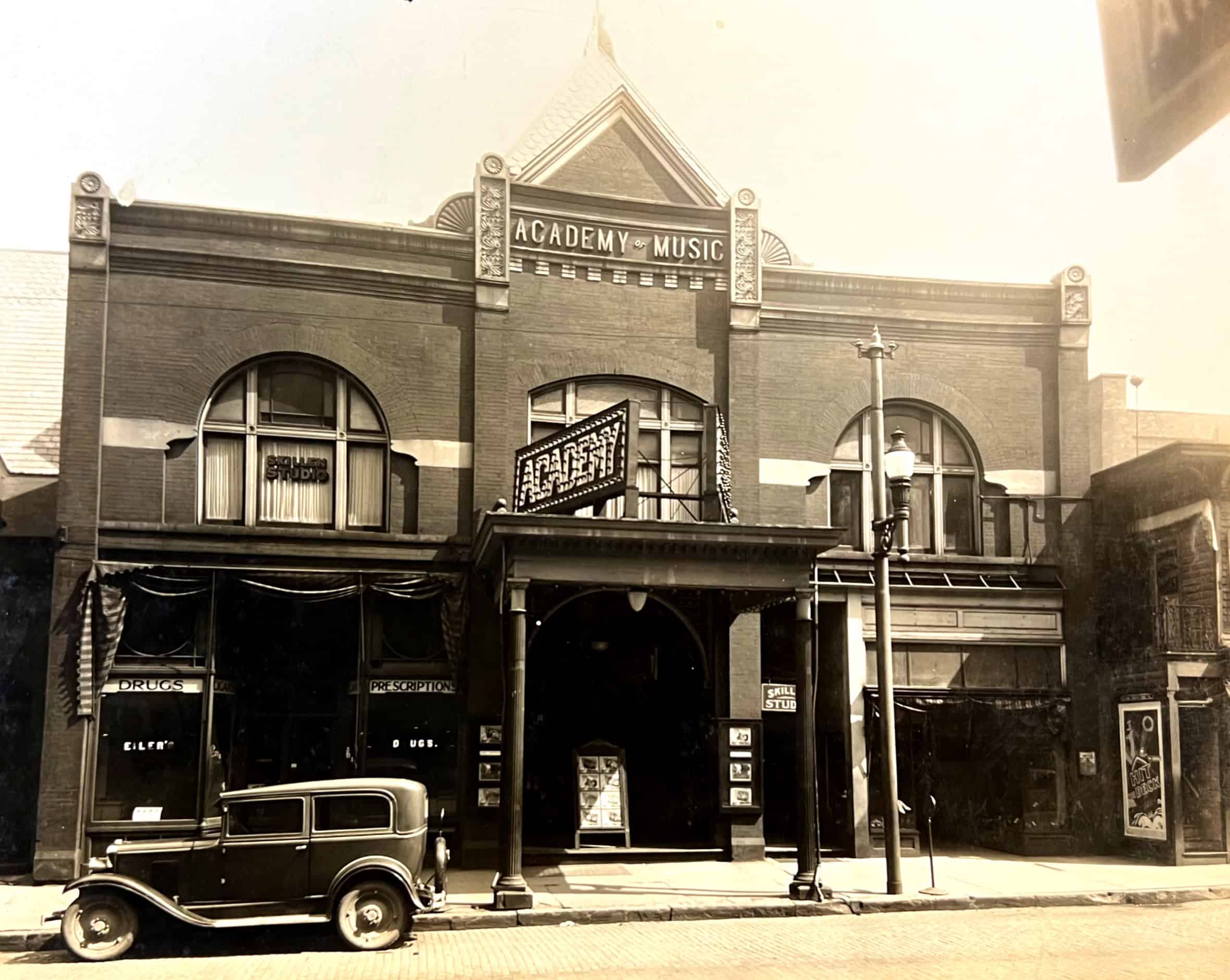
Academy Theatre, Meadville, Pennsylvania, Collection of the Crawford County Historical Society
Now that an adequate theater existed, extravagant productions increased to an absurd degree. Trains rushed across the stage, and I am sure there must have been distressed damsels tied to the tracks to be saved by a brawny hero. Fire engines wailed, boats sank – thunder and lightening – you name it – they had it. A performance of Faust had electrical effects such as crosses, flowers and dragons passing through the air. The gay nineties were in full swing and the theater was beginning to commit a slow but sure suicide – at least this was true of the traveling theater companies. The movies were beginning – at first called galloping tintypes – from old film clips, we understand why, Meadville audiences, as time went on, found that movies could be even more exciting and elaborate than theater. One cannot point with any exactness to a particular moment that theater died, but Bernard Engle used 1899 as the beginning of the end for Western Pennsylvania.
Frederic Howe’s Account of Meadville
Even by the 1880’s the more pious people of Meadville had had enough, Theater was almost a dirty word, and actresses and actors evil. As strong reactions usually do, they were throwing out the baby with the bath. General reaction against the excesses of the theater were country-wide with the exception of the large cities, and traveling companies were fewer and fewer. There seemed no way to keep the good plays and the opera company without the tasteless because it was the later that brought in the money. Unfortunately, reaction against theater included one against dancing, card-playing, and of course, alcohol, but, and this was more serious, any deviation from rather pious mores.
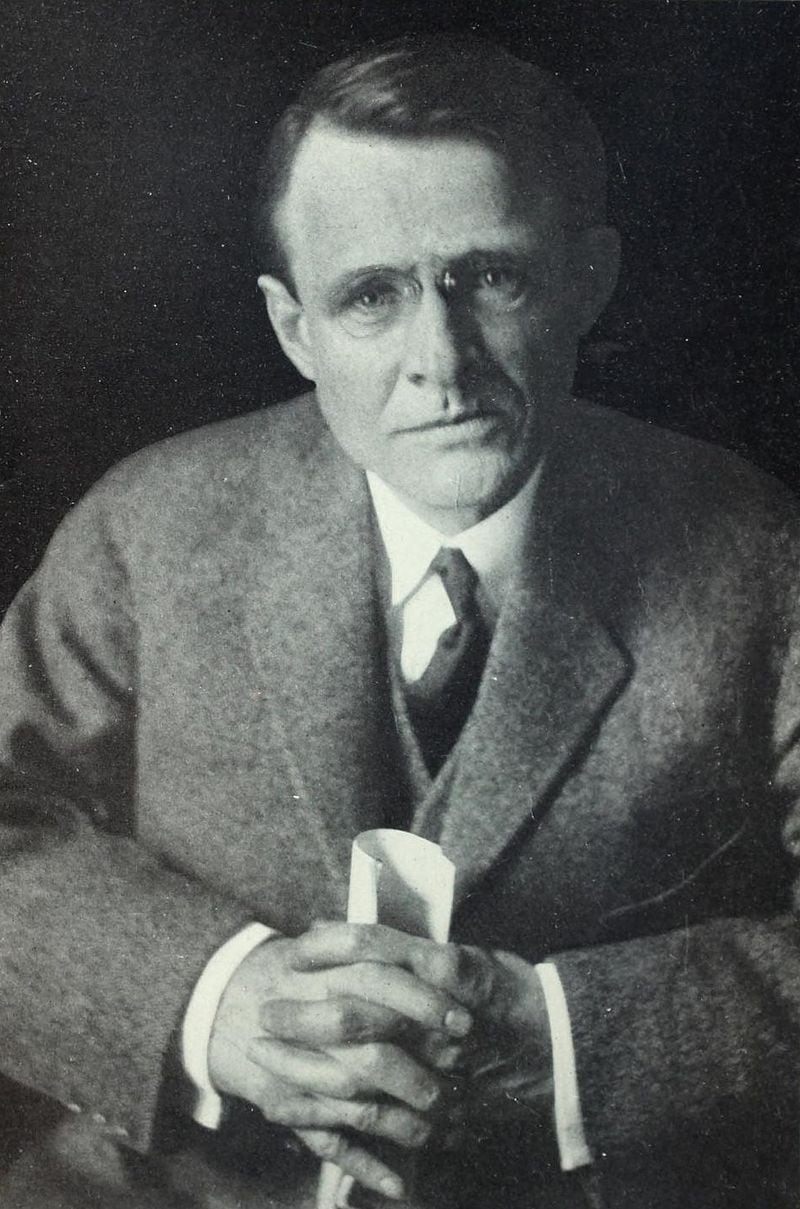
Frederic C. Howe, American lawyer, progressive reformer, author, member of the Ohio Senate, Georgist (advocate of a single tax), and Commissioner of Immigration of the Port of New York (Ellis Island). He was also founder and president of the League of Small and Subject Nationalities.
To illustrate what I mean, I want to quote from a book, published in 1925 by Frederic Howe, called Confessions of a Reformer. Howe was born in Meadville in 1866, graduated from Allegheny 1889. When he was 25, he left Meadville for Johns Hopkins University. While working for his Ph.D. he had Woodrow Wilson as a Professor, and after World War I, he worked with Wilson in Paris at the League of Nations conference. In his book there is a chapter, a short one, on Meadville and Allegheny College, and he gives us a picture of climate a cultural church of piety and conformity, unopened to new ideas. To quote Howe,
“Neither of my parents had interest in reform. They did not want the world changed. It was a comfortable little world, Republican in politics, careful in conduct, Methodist in religion. Unitarians were beyond the pale. My father had a quiet broad-mindedness which was unusual in the comnunity. Fellow churchmen did not understand his going – to hear a Unitarian minister who had formerly been a Methodist. The apostasy of Dr. Townsend had been in the nature of public disgrace. Life-long friends shunned him.” Howe says his family allowed him to go or not go to church when he was a youngster, but since he was in love with his Sunday School teacher and liked the parties with the girls of Ida Tarbell’s class, he went. To quote him again, “I escaped more than my sisters from the Methodist espionage of conduct. I went to the only dance in town, in the Hall of the Taylor Hose Co. I played cards with a colored driver in a barn – and with my father’s connivance I went to the theater. That was a secret between the two males of the family—– I would meet my father casually when supper was over, ‘Like to go to the Opera House to see Barret’ or it might be Joe Jefferson or Modjeska – I saw them all from inconspicuous seats in the top gallery – so much concession was made to ‘what will the neighbors think?'” I would like to say here that in the Centennial edition of the Meadville Tribune, I found no mention of the stage that came to Meadville from 1864 to 1888, when it was published – a skeleton in the closet that was almost unmentionable. The Sesqui-Centennial, on the other hand, does a very good article on the theater. But to return to Frederic Howe. He had three other escapes as a boy – one was playing with the Irish boys who lived in shacks along the banks of the canal. Some of their mothers smoked pipes and their fathers worked on the railroad. Another was the Public Library – and he enjoyed hanging around the presses and printing offices of the local paper. He learned that to be a Democrat was as bad as being Unitarian, and to be both was almost a criminal deviation from the norm upheld by the proper and the saved. (A note to state that, at this time, conservatism and liberalism were reversed with Republicans and Democrats. It wasn’t until roughly the 1920s/30s that Democrats became the liberal party and Republicans their conservative counterpart).
When Howe went to Allegheny, the atmosphere was little better. I quote, “Many of our professors were retired ministers or missionaries who knew little about the subjects they taught.” In college his main pleasure was working on the college weekly and he said, “The furtive and forbidden amusements of theater-going, card-playing and dancing, were but slightly diverting as compared with the joy of working over an editorial column.” There were winter revival meetings at the college and in town. “Freshmen and sophomores were alloted to seniors, who took us on long walks and enquired about our souls. Night after night they herded us into Stone Church. There revivalists prayed, worked on our fears, made us feel we were eternally damned if we went without their particular brand of religion.”
The summers of his junior and senior years in college he worked in a hotel at Chautauqua. He went to lectures and was particularly interested in those on political economy given by Richard T. Ely of Johns Hopkins University. As he wrote, “they made me want to know more about the big world outside my little home town.” He left a Wasp society, though I do not think the word was yet invented.
This ends the first of two parts of “The Cultural Climate of Meadville: From 1800 – 1900.” Next issue will bring with it, culture as shown in the local newspapers, music history, the library, the Historical Society, Art Society, and more. Stay tuned!

References
This essay was written from the files and newspaper collection of the Crawford County Historical Society in 1974.
About the Author
Carol M. Ross was a member of the Women’s Literary Society of Meadville and presented this paper on March 1, 1974 to its members. It is being split into two parts for publication length. Any commentary and views made within the article are hers alone.
Sign Up for Our Newsletter
Get the latest Crawford County Historical Society news and information delivered right to your inbox.
"*" indicates required fields