
Back to Articles
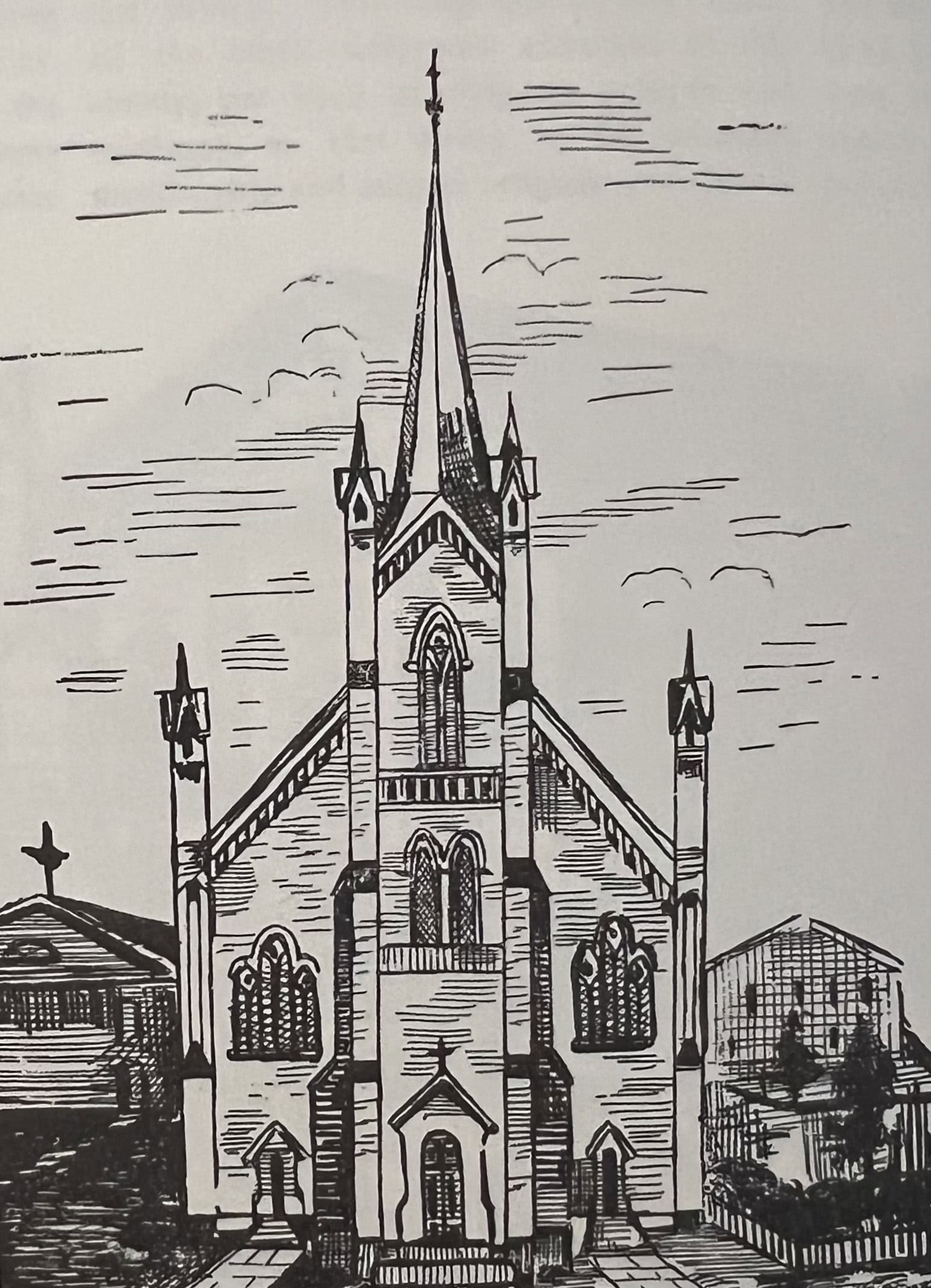
St. Bridget Church from the 1888 Centennial Edition of the Tribune Republican.
Note: The spelling of the church’s name is used differently in the modern and historical contexts. The 1888 article from the Tribune Republican History of the area lists the name as St. Bridget while the modern listing states St. Brigid.
All of the Catholics in this vicinity he longed to St. Agatha’s church until the spring of 1862, when St. Bridget’s church was organized. Some of the original members were John Riordan, Thos McGuigan, James O’Connor, Walter Furlong, Richard Wheelan and Thomas Breen, with their families.
On the 13th of May, 1862, Thomas McGuigan and James O’Connor, on behalf of the congregation, rented the building then known as “Divinity Hall,” which stood on the southeast comer of Center street and Chauncey lane, where mass was celebrated and the gospel preached in the English tongue. An influx of English-speaking Catholics, in 1862, swelled the numbers of the little congregation, and “Divinity Hall” was purchased for the sum of $750. It was dedicated by the Rt. Rev. J. M. Young, Bishop of Erie, and the congregation placed under the charge of Rev. M. A. De La Roque, of Frenchtown. It was principally attended by his assistant, Father Gilibarti, who finally, in 1863, was appointed the first resident pastor. In 1865 Father De La Roque again took charge of St. Bridget’s, and was settled here as resident pastor. Early in 1866, Father De La Roque purchased the old Methodist church and parsonage on Arch street, near the corner of Liberty, for the sum of $7,000. It was fitted up and dedicated the same year by Bishop Domenec, of Pittsburg. The old property on Center street was then utilized for school purposes, but was subsequently sold for the original purchase money. Rev. James Perry was assistant in 1865, and Rev. James Haley a portion of 1866. The latter was succeeded by Rev. John L. Finncane, who became pastor in 1868. He was a native of Ireland, and was a well known lecturer and an eminent pulpit orator. He served as pastor of St Bridget’s until June, 1871, and died in Brooklyn, N. Y., some four or five years afterward. Rev. John L. Madigan was the next pastor of the church; he, too, being a native of Ireland, but ordained by Bishop Young, of Erie. During his pastorate the present school building l was erected. In March, 1874, Rev. James J. Dunn became pastor of St. Bridget’s, and furnished and opened the school in the following September. In 1877, Father Dunn purchased the lot on the northeast corner of Arch and Liberty streets for $1,500, and moved the old parsonage on to it. The time had now come when St. Bridget’s needed a new church, and on Sunday, August 11, 1878, the corner-stone of the present beautiful brick edifice was laid by the Rt. Rev. Tobias Mullen, of Erie, in the presence of a large concourse of people, who had gathered from every portion of the county to witness the impressive ceremonies. It was carried to completion and dedicated November 24, 1881, by Bishop Mullen, assisted by a large number of priests of the diocese and Bishop Gilmour, of Cleveland, O., who preached the dedicatory sermon. The church cost, complete as it stands today, about $15,000, and has a seating capacity of about 600. (As of 1888)

References
Centennial Edition. The Tribune Republican. Vol III No. 1177. Meadville, Pennsylvania. May 12, 1888. Page 78.
Sign Up for Our Newsletter
Get the latest Crawford County Historical Society news and information delivered right to your inbox.
"*" indicates required fields