

Back to Articles
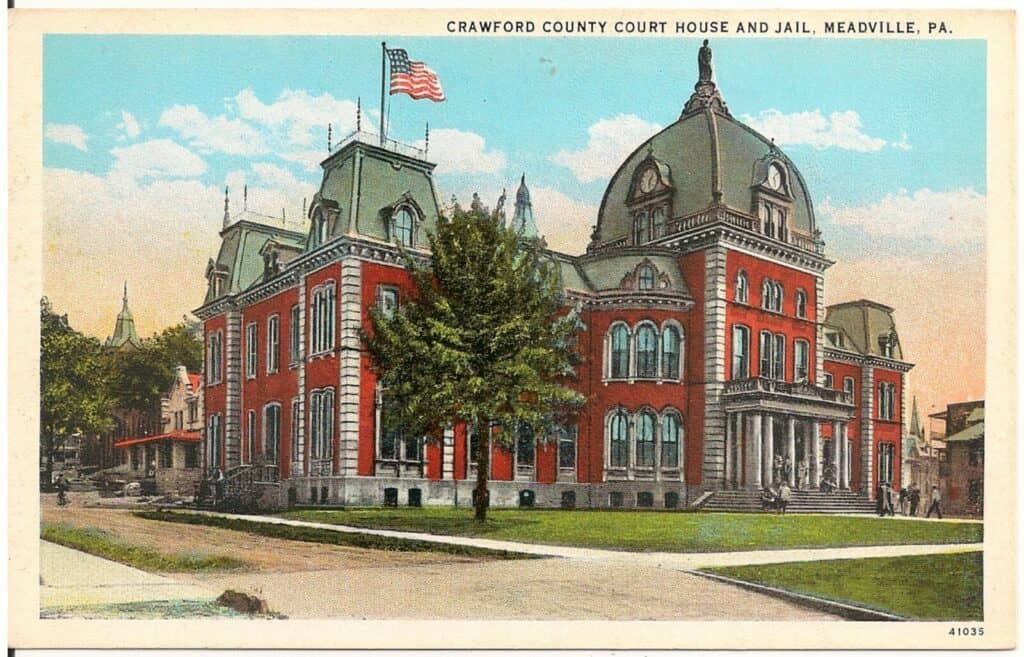
2025, marks the 117th anniversary of one of the more gruesome episodes in the long history of Crawford County’s old jail.
It all begins on Christmas Eve, 1908, when Jack Cronin uses a .32 revolver to shoot his childhood friend, Harry Winters is shot multiple times with a .32 revolver. Shot three times, Winters drops to the ground. Jack Cronin, runs a block from the scene of the crime on Mead Avenue, in Kerrtown, Vernon Township, to the house of Charles Hope, who convinces Cronin to surrender to the police. Cronin does just that, saying of Winters “Yes, I shot him, and I would do it again if I got the chance. I am not sorry that I did it and I hope the ——- will die.”
But Winters isn’t dead by the time of Cronin’s arraignment. The charge is “feloniously and maliciously wounding with intent to kill and malice aforethought.” District Attorney O. Clare Kent reserves the right to change the charge if the victim dies. Pennsylvania law, borrowing a rule from the Old English, makes it murder if shooting victim Winters expires within one year and a day of the attack. Given three serious gunshot wounds and the state of medical care in 1908, you might think Harry Winters would be dead in short order. You’d be mistaken. The victim holds on in Meadville’s Spencer Hospital for a week, then two, then a month and longer, all the while suffering through extensive medical treatment.
One bullet plowed through the bottom edge of his breast bone, tore his bowel, and lodged in the muscles of the back above the left kidney. Winters surrenders a nearly fatal volume of blood to that wound and subsequent surgery. A second shot entered the body under the right arm. An operation is required to remove the damaged ribs and associated infection, and to place drainage tubes. This is done under local anesthesia because Winters is too weak to take the chloroform a second time. A third surgery is later performed to remove the bullet lodged in his hip.
Winters eventually develops pneumonia, but then seems to be recovering when he dies suddenly, “his whole system thoroughly saturated with poison.” It is the last week of February, 1909. As promised, D.A. Kent changes the charge to first degree murder. Cronin admits the shooting and the crime. He wants to plead guilty and hang as soon as possible.
President Judge, Thomas Prather won’t allow a guilty plea to murder in the first degree because, in 1909, it holds an automatic sentence of death. Judge Prather considers such a plea as suicide through the courts. There has to be a trial. Waiting for justice is tough. Cronin grows erratic. He shows the jail physician, O.H. Jackson, several small, red marks on his body, one directly beneath his heart, and describes being attacked by a gang of men that held him to the jail floor and “thrusted sewing needles” into his body. He’s in cell by himself and so the outrageous story is dismissed as the ravings of a man crazed by guilt. He is in poor condition, the doctor allows, but recovery is likely.
The prisoner is placed on suicide watch—denied knives, forks, or anything else he might use to injure himself. Not that it matters. On April 25, after a great deal of suffering and frightful pain, Cronin dies in his cell at 10:10 in the evening, four months and a day after the shooting.
His autopsy finds five large and rusty darning needles inside his body. Two traveled to the lower right and pierced his liver. Three migrated to his lower left, puncturing organs along the way. The spleen is damaged, undersized, and “dried up.” Doctors W.D. Hamaker, O.H. Jackson, and W.B. Skelton decide the needles certainly produced Cronin’s suffering but could not have killed him. Opening his skull, they find meningitis. All testify that death was caused by the brain infection and not the large, corroded needles. The doctors decide, and the coroner agrees, that the murderer died of natural causes, not suicide. But Jack Cronin is dead, all the same.
A clear motive is never established for the crime. Some claim the shooting is the whisky-bolstered result of a ten-year feud that began when the victim’s father, a Kerrtown Constable, arrested Cronin’s brother. Others are sure it is the tragic end to a love quadrangle between the two men, an Erie Railroader, and his wife. People say the woman loved Harry Winters more than the other two and that Jack Cronin shot Winters out of jealousy.
Whatever caused one man to kill a lifelong friend remains unknown. The papers, noting both men have gone to a Higher Court, say it best: The motive “will probably never be known except to the district attorney’s office and to the Almighty.”
About the Author
This true-crime story is part of Don Hilton‘s book, Murders, Mysteries, and History of Crawford County, Pennsylvania, 1800-1956. This book will soon be available at the Crawford County Historical Society and wherever books are sold.
Sign Up for Our Newsletter
Get the latest Crawford County Historical Society news and information delivered right to your inbox.
"*" indicates required fields