
Back to Articles
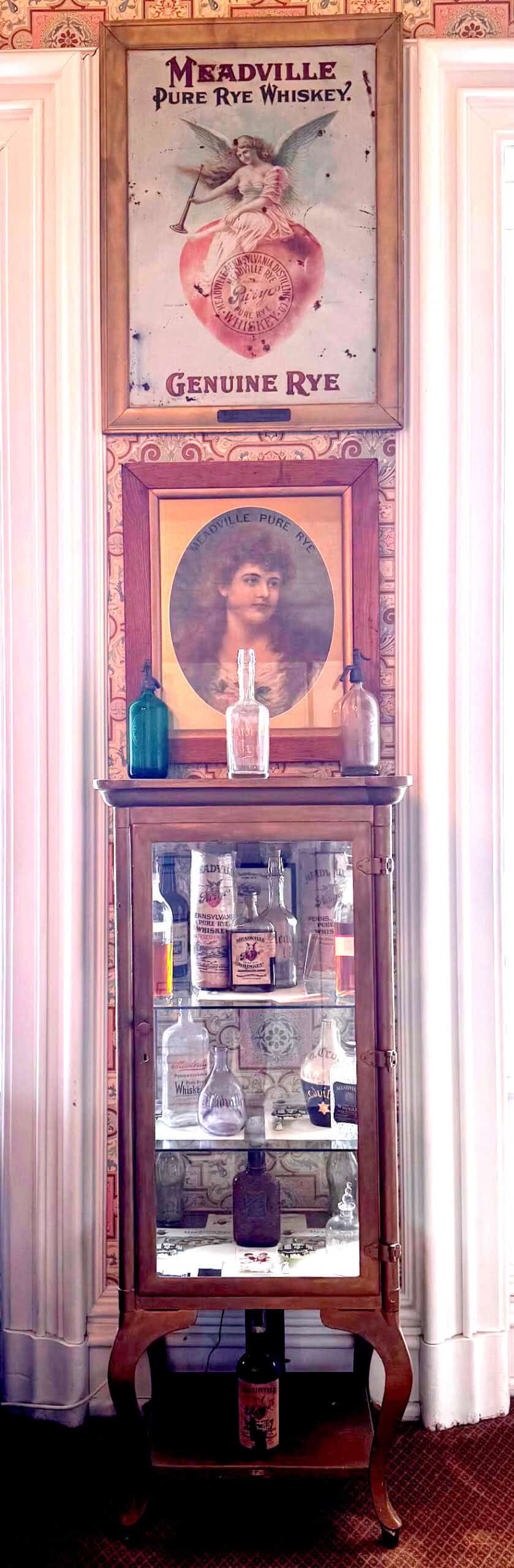
Meadville Rye Artifacts in the collection of the Crawford County Historical Society.
With the recent opening of Cussewago Square, it seemed appropriate to take a moment to bring attention to the history of the location, as well as to take advantage of the opportunity to highlight one of the many fascinating collections being preserved and displayed by the Historical Society. If you stop into the Tarr Mansion, located at 869 Diamond Park in Meadville, take a moment to look at our Meadville Rye Whiskey exhibit located in our Microfilm Room. Thanks to the George Deshner Estate and several other generous donors, we, at the Society, have a fairly comprehensive collection including a mash paddle, shipping crate, bottles- including two direct from barrel (undiluted) bottles (104 and 109 proof) of the original rye whiskey itself, and other memorabilia related to Meadville Rye Whiskey which, was previously in operation on the Cussewago Square property in Meadville’s Fifth Ward. In fact, several of the original brick buildings still stand to this day.
The following is the history of the location as outlined by the current owners of the Cussawago Square Project:
From Rye to Revival
In 1860, Meadville’s first full-production distillery—Peifer & Richards—began operations on the site that now anchors the Square. After a series of ownership changes, the company formally adopted the name Meadville Distilling Company in 1885.
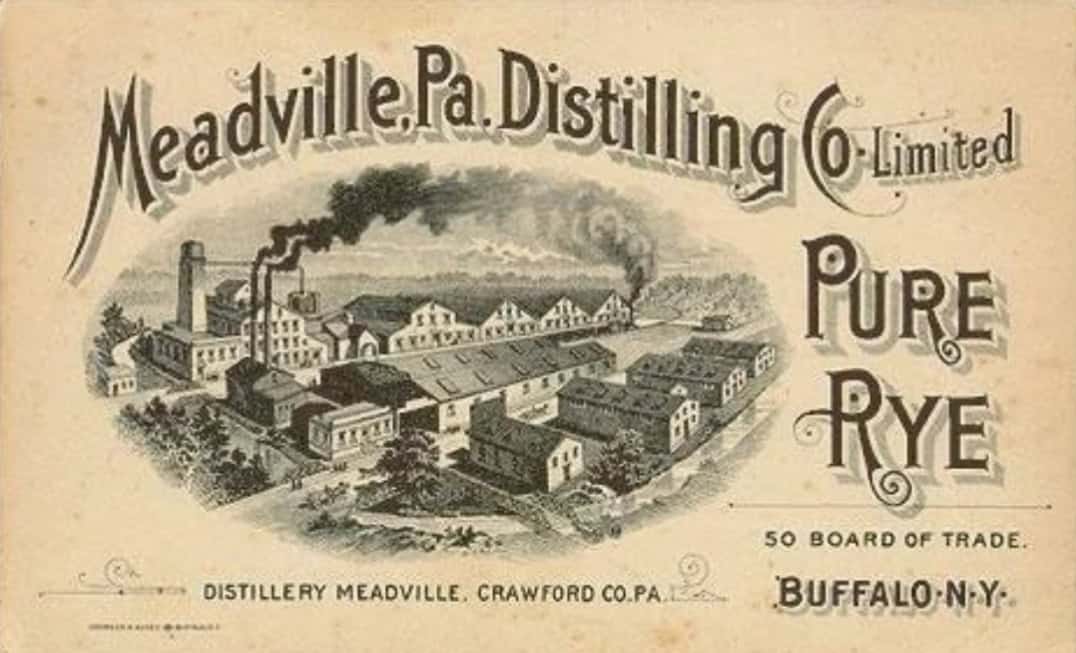
Meadville Pa Distilling Co.
During the 1890s, the distillery underwent rapid expansion, constructing three massive brick warehouses—each seven to eight stories tall with over 3,300 square feet per floor, and 3 other large brick buildings:, a drying house, a fermentation house, and a barrel house. These buildings were among the largest in the region and put Meadville on track to become a major player in the national distilling industry. The warehouses were later torn down, but the other buildings still stand today.

Mash Paddle donated by Sherry O’Day to the Crawford County Historical Society. Paddle was discovered in the walls of one of the buildings at the facility and was given to the family by Ray Spaulding.
In 1901, the company officially incorporated, and by 1905 had added a new brick distilling house, a drying plant, and a boiler house—doubling its production capacity.
Distilling to Decay
But in 1919, Prohibition changed everything. Meadville Distilling reorganized to produce ginger ale under the name French Valley Springs, but the venture failed, and operations ceased by 1924. Following the repeal of Prohibition in 1933, local investors revived the distillery and resumed production of Meadville Rye in 1937. During this period, the high tower that now houses part of Cup n’ Spoon was constructed, replacing the pre-Prohibition warehouse.
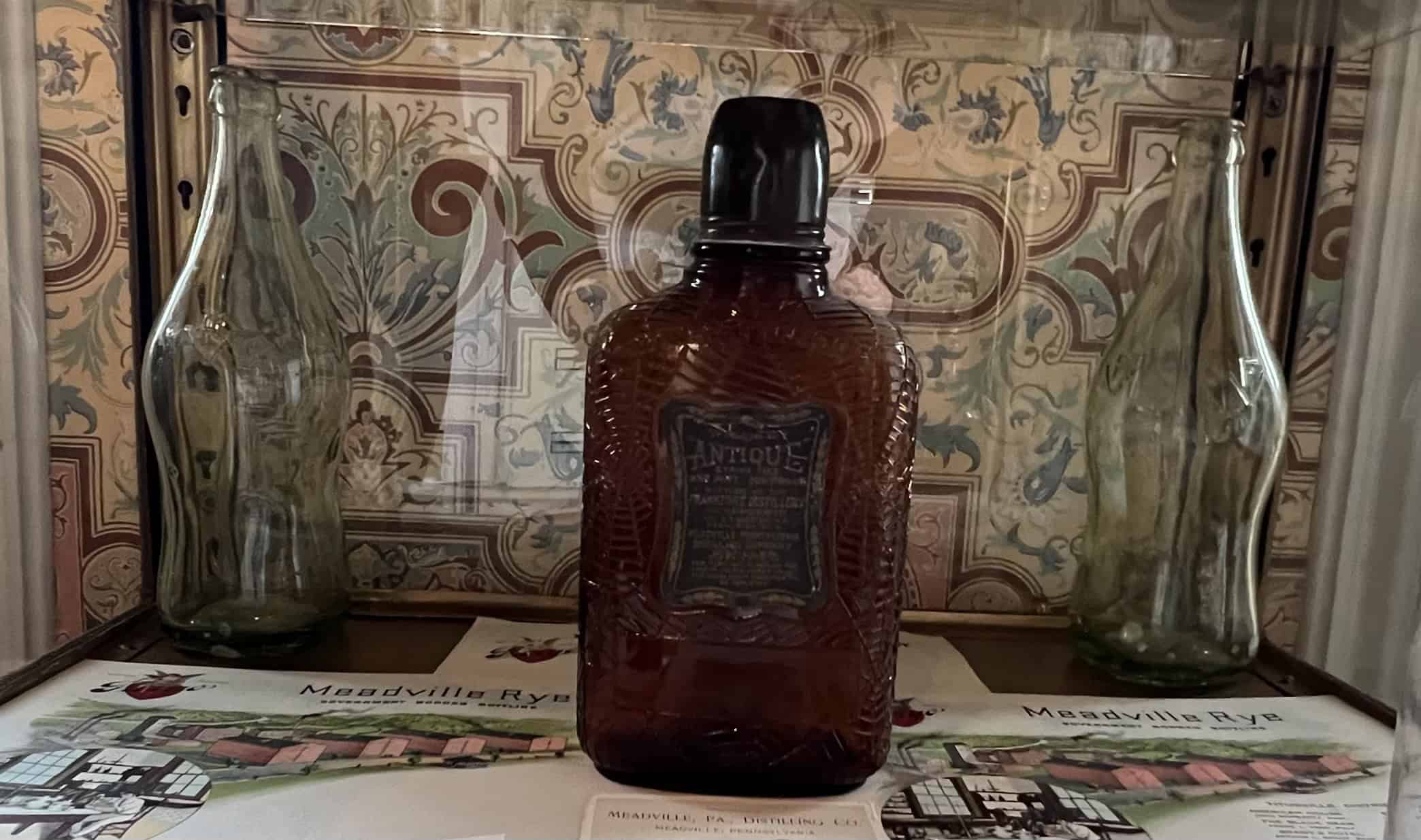
The green glass bottles on the left and right are French Valley Springs bottles, from the period post Prohibition.
Despite this brief revival, the distillery could not recover from the lasting effects of Prohibition. In 1947, Meadville Distilling closed permanently, and by 1951, all production had ceased. The site took on new life in the late 1950s as Race Street Lumber, a successful lumber yard that operated for several decades before closing. The property was ultimately abandoned in 1993, and for 30 years it deteriorated—its historic walls fading into silence.
A New Era
In 2022, the Crawford County Historical Society purchased the long-abandoned 7-acre property and began site clearing. A year later, in 2023, Rob and Nancy Smith, through their investment company RAN Investments, acquired the site from the Society and launched a full restoration effort, transforming the eight remaining buildings—including four original 1890s brick structures—into what is now Cussewago Square.
In 2024, RAN Investments expanded the project
– Acquiring the adjacent Neilson Warehouse and land, a 1-acre plot that was originally part of the distillery complex, the building built on the foundation of one of the large brick warehouses
-Purchasing 7.5 acres along Cussewago Creek, making way for future hiking and biking trails
These restorations are ongoing, with the full Square opening in summer 2025, and additional renovations planned through 2026.

References
Editor’s Notes:
This article, with a major portion provided by Cussewago Square, is featured in the Fall 2025 edition of the Crawford Messenger print edition, Crawford County Historical Society’s newsletter and journal.
About the Author
Kimberly Sherretts is the archivist and curator at the Crawford County Historical Society. Originally from Mosiertown, PA (near Cambridge Springs and Saegertown), she now lives with in Meadville, PA with her family.
Cussewago Square provided some of the text for this article on their website. They can be found online at https://www.cussewagosquare.com/
Sign Up for Our Newsletter
Get the latest Crawford County Historical Society news and information delivered right to your inbox.
"*" indicates required fields