

Back to Articles
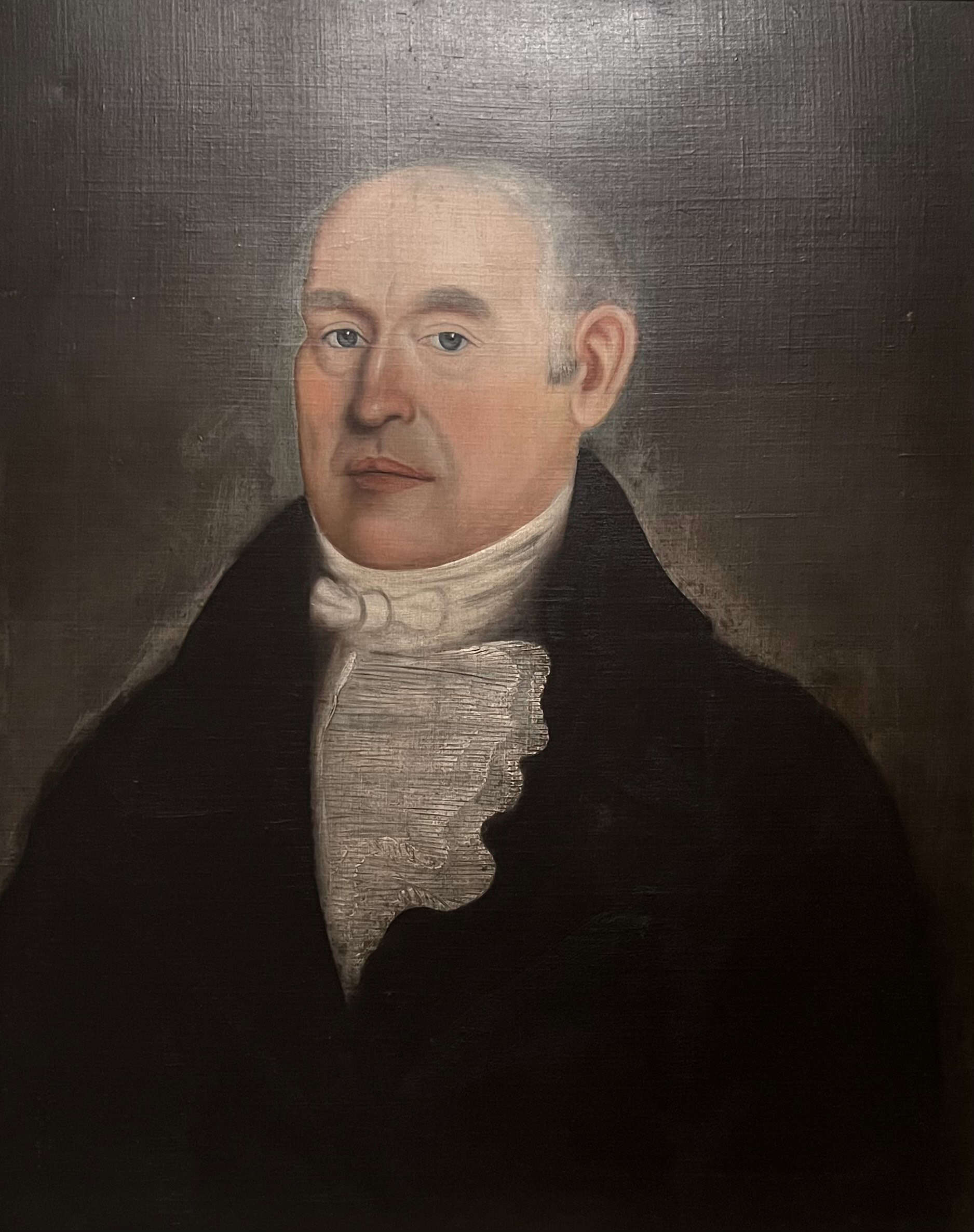
Portrait of Judge Jesse Moore by artist James Bowman. Collection of the Crawford County Historical Society.
On the fifth of April, I803, Jesse Moore was appointed President Judge of the Sixth Judicial District of Crawford County by Governor Thomas M’Kean, succeeding Judge Alexander Addison who was the first Judge of this District. At the time of his appointment he was practicing law at Sunbury, Pa. With this appointment, Meadville became his place of residence where he continued to live for the balance of his life. Judge Moore was described by the late Hon. S. P. Johnson as “A gentleman of the old school, dignified but courteous, learned but not brilliant, characterized by stern integrity and freedom from all prejudice. He was short and thick-set, with a benignant countenance, partly bald, and wore a broad brimmed drab-colored hat.”
Crawford County was the only seat of justice west of Pittsburgh until the organization of the courts in Erie, Mercer, Beaver, Butler and Venango. The judge and non-resident attorneys rode the circuit on horseback over rough wood-cut roads and bridle paths, often occupying many days or even weeks on their journeys. Judge Moore presided at the opening of the first courts in the organization of the Counties of Erie and Mercer in I803, Beaver in I804, Venango in I805 and Warren in I8I9.
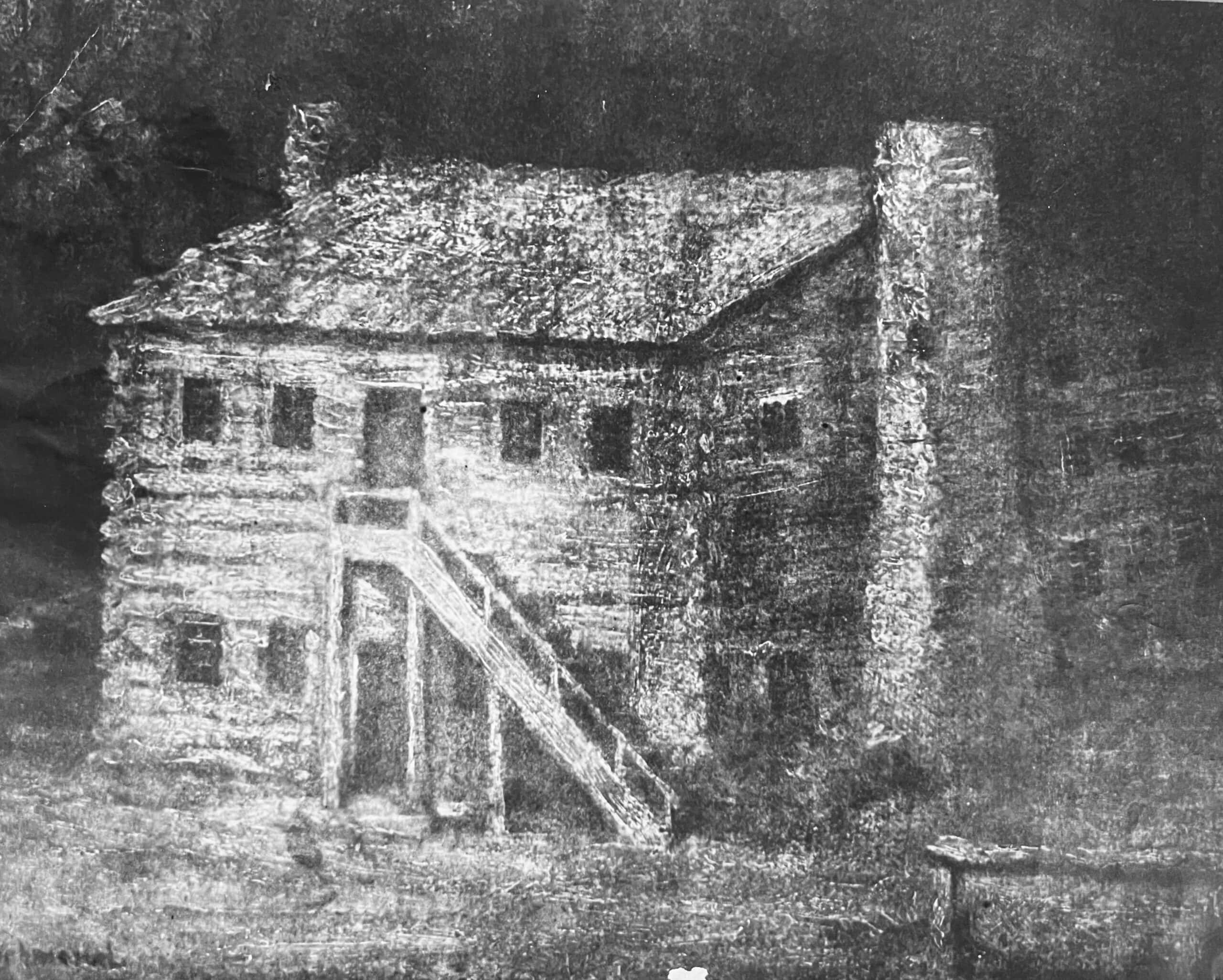
Copy of a painting by A.G. Richmond of the first courthouse. It was constructed in 1804 and used until 1824.
The first court in Meadville was held in the upper story of William Dick’s house on Water Street at the corner of Cherry Alley. It was in this building that Judge Moore had his chambers for which he paid rent to William Dick at Ten Dollars a quarter. In I804 the county purchased two lots on the west side of the Public Square and thereon erected a log court house and jail. The court room was on the second floor and leading up to it was a double outside stairway at the front extending over the entrance to the jail. In this room Judge Moore presided over the court for practically twenty years, and many important cases were tried by a very able bar. The bench for the judges was at the south end. The seats for the bar and jury were semicircular and, like all the room furniture, were unpainted pine. Tin sconces on the walls and tin candlesticks with dipped tallow candles furnished the light. Here too, the ‘court crier,’ Dick Jan Newenhausen, better known as ‘Dutch John’, who likewise served in other capacities as ‘town crier,’ auctioneer, butcher, mail carrier and man of all work, who under instruction of a facetious attorney opened the first court with this conclusion: “God save the Commonwealth and bless its most honorable crier.”
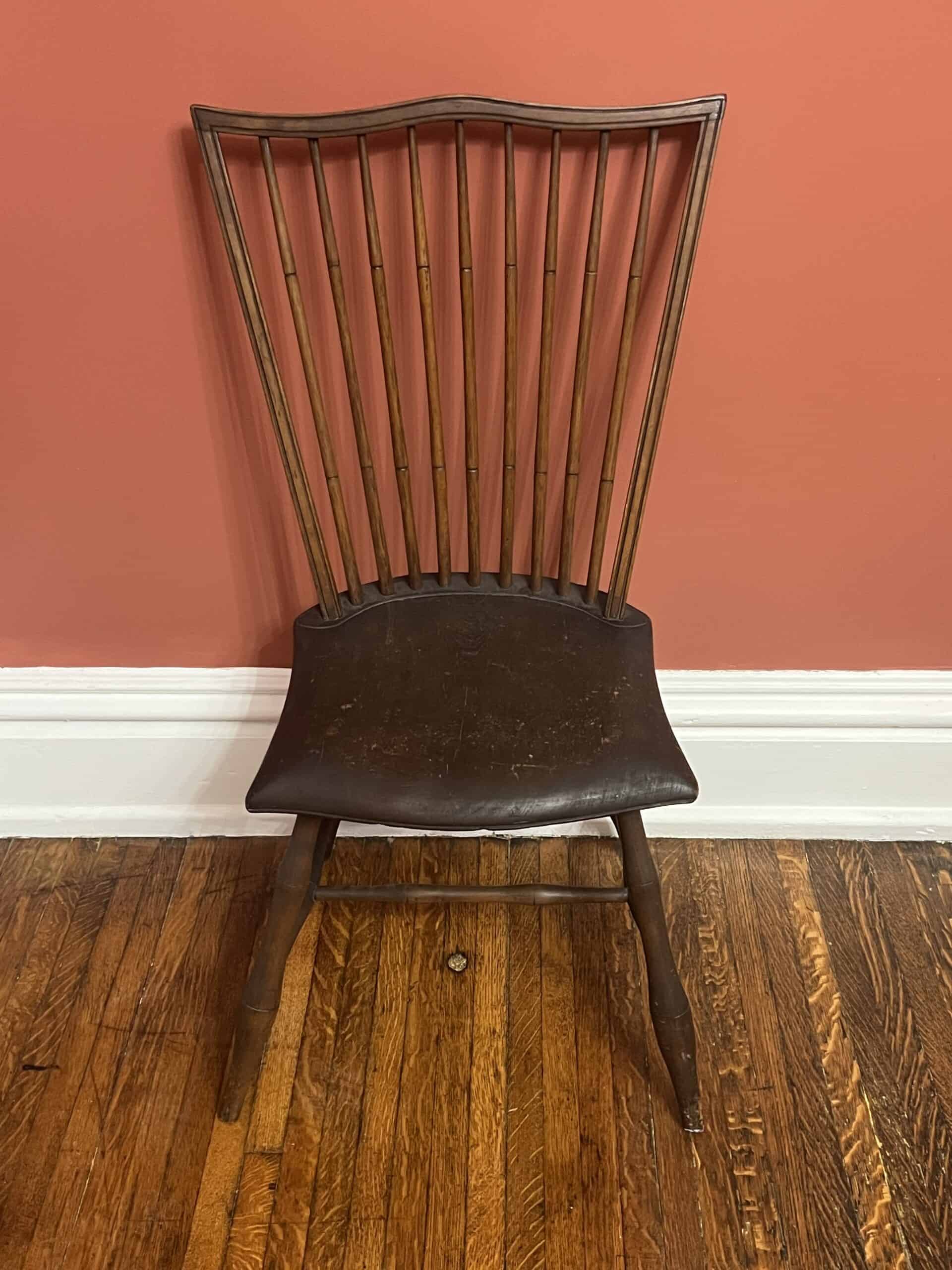
Original chair from Judge Jesse Moore’s courtroom at the first county courthouse. Part of the collection of the Crawford County Historical Society.
During the years of residence in Meadville Judge Moore between the sessions of court held there, rode on horseback to Erie, Franklin, Mercer, Butler and Beaver to hold court usually four times a year in each place. Receipts from the taverns in these towns where he stopped included hay and oats for his horse as well as food and lodging for himself.
In a history of the Beaver Bar Judge Moore is described as “well educated, a good lawyer, discreet, upright and 1m-partial. He at all times sustained the honor and dignity of the profession. He was a heavy, solemn looking man, and retained the dress of the ‘old-time gentleman. Small clothes, knee buckles, shoe buckles; bald headed but long hair behind and done up in a queue; coat covered with white powder sprinkled thereon.”
When the Meadville Society for the Encouragement of Domestic Manufactures and the Useful Arts was organized in 1807, an organization whose function corresponded to the Chamber of Commerce of today, the name of Jesse Moore appeared with those of Dr. Thomas R. Kennedy, John Brooks, John Reynolds, Ralph Marlin, Roger Alden, William McArthur, David Mead and Thomas Atkinson among others.
Of the five Meadville men who were members of the American Antiquarian Society of Worcester, Mass., Judge Moore and Major Roger Alden were elected to membership in I8I5.
The Meadville Bible Society was organized July 20th, I8I5 and the preamble to the constitution began: Considering the incalculable benefits, which have resulted to the world from a dissemination of the truths of the gospel… and that there are many in this region, to whom, we have good reason to believe, a donation of the Holy Bible would be a most suitable, acceptable, and profitable charity;
We, the subscribers, voluntarily associate ourselves together…
At the next meeting on August I5th twelve directors were elected which included the officers:
Roger Alden, President
Hon. Jesse Moore, Vice-President
Rev. Timothy Alden, Cor. Sec.
Rev. Robert Johnston, Rec. Sec.
John Reynolds, Treasurer
Dr. Daniel Bemus, Auditor
The Society continued its work for many years.
Allegheny College was established by Act of Legislature December I2, I8I6 and on the list of names of the first trustees appointed by that Act Judge Moore was mentioned among those from Meadville. He had contributed $300. to the College fund. The history of the Board of Trustees is notable for the few men who have held the position of president. Timothy Alden first served as president for one year at the same time being President of the College, and in I818 was succeeded by Hon. Jesse Moore for one year.
On coming to Meadville Judge Moore first boarded with David Mead, and afterward until I8I2 at the Gibson Tavern. Most of the visiting attorneys of an early day made the Gibson Tavern their headquarters while attending court in Meadville, as it was famous for its excellent accommodations and bounteous food. Apparently the Judge appreciated good food and good liquor as well as a place where he could entertain his friends. Receipts given by the Gibson Tavern include such items as, December 25, I804, dinner and club for Roger Alden and Doctor Kennedy, followed by supper for Messre. Alden, Kennedy and Clark, and another item ‘Deduct two clubs paid for P. and J. Huidekoper. ‘ The year after he entertained at dinner with club Messrs. Baldwin, Wallace, Collins and Semple. In I806 he had a Christmas dinner for fourteen guests and some time later Messrs. Alden, Marlin, and Watts joined him at dinner and club. Two years later he had as guests David Mead for New Years and the following month Judah Colt dined with him.
On September I5th, I804, the Judge moved into a house which he rented from H. J. Huidekoper and occupied for a year paying his landlord $73.33. In July of that same year Col. Hackney gave a receipt for goods given to Black James who was in the employ of the Judge. While in the Judge’s service James Fraser was well cared for as is shown by the numerous bills the Judge paid for his clothes, shoes, hats, etc. Elizabeth Newenhausen charged ‘five shillings and seven pence half penny for washing one dozen of clothes.’ Work & Aston’s bill for Linsey and thread for Blackman was paid by the Judge. James’ usefulness came to an end in October I805 when he signed a slip of paper on which was written ‘Received of Jesse Moore one dollar in full of all demands.’
From April to July of I806 Judge Moore lived in the house of the late William Moore on the south side of Walnut Street which he rented from Dr. Thomas R. Kennedy• From I8I2 to I8I5 he occupied a house owned by James Herriott and after that rented a house on the Public Square from Henry Hurst. In I8I6 the Hurst house was sold to Joseph T. Cummings and the Judge continued to live there until the time of his marriage. It was in the summer of I8I2 that he started boarding with Mrs. William Dick who eventually became his wife.
It would seem that most any scrap of paper was acceptable for writing a receipt. ‘The first day of Jany. I8I6 received of Jesse Moore two dollars for a cord of hickory wood. ‘ Signed: George Wheelen. The paper used for this receipt was the top margin of The Carrier’s Address for the New Year printed by the Crawford Weekly Messenger. Paper was scarce and the carrier’s address was handy. On the 5th another receipt was written on another section of the same address for the same amount of hickory wood. This part was taken from the body of the poem which constituted the address so a portion was saved for posterity:
“From these base scenes Let’s take a peep across the Atlantic flood: of despotism and blood, Here, at our own fire-sides, though cold the climate. Backs froze and fingers numb, we’il try to rhyme it.”
Judge Moore read extensively, not only the local paper but for years subscribed for the Country Aurora and the Freeman’s Journal published in Philadelphia and the Weekly Register of Baltimore. He was a subscriber to the Erie Library Company and the Meadville Library Company. Constantly he was purchasing new books for his own library, the bills for which ran into hundreds of dollars, many of which came from Mathew Carey in Philadelphia, Zadok Cramer of Pittsburgh and William Connely at Franklin.
Among other things to which he subscribed were the Fire Company, a bridge over Mill Run and a fence for the Burying ground. Other receipts show that he paid a regular stipend to the Rev. Robert Johnston for a period of years.
In matters of dress he was particular, buying clothes in Philadelphia, Baltimore and Pittsburgh when the opportunity offered. He was a steady customer of Eliphalet Betts, a local tailor, who not only made clothes for him but also kept them in order. Prices at that time were quite different when Bette would make a great coat for $4.37 1/2. He bought Castor and Roram hats from Samuel Withrow, boots and shoes from John Robertson, Andrew Johnson and John Achenbauch.
The manner of conducting business at the Meadville Post Office in Judge Moore’s time was very different from that of the present day. Every two or three months the Judge would receive a bill for postage on letters and newspapers, the receipts for the same were signed in turn by Edward Work, James Gibson, Henry Hurst and Daniel Andrews as Post Masters.
In writing to a friend Miss Mary Reynolds told of the approaching marriage of the Honorable Jesse Moore to Mrs. William Dick, remarking that he had been a long time making up his mind. As the Judge had boarded at Mrs. Dick’s house for five years it would seem that he had ample time to consider the matter. November 7, I8I7, the Crawford Messenger printed this announcement:
Married on the 1st inst. by T. Atkinson, Hon. Jesse Moore to Mrs. Anna Dick. At that time Mrs. Dick had four of her sons living at home in the stone cottage across Chestnut Street from the Academy at the corner of Liberty Street, John, David, James R. and William Wilson, the latter two being still in their teens. The Moores continued to live in the same house and the young men held an affectionate regard for their step-father. James later named his first son for the Judge and David was one of the executors of the Judge’s estate.
In writing his recollections of the early days, General John Dick said:
“In April, I803, Hon. Jesse Moore was appointed president judge of the judicial district composed of the counties of Butler, Beaver, Mercer, Crawford and Erie. The entire circuit was performed on horseback, there being no public conveyance of any kind for many years after. The roads in the spring and fall seasons were almost impassable. Judge Moore continued to preside from that period until his death,.. It is a remarkable fact that in all the twenty-one years of his administration he never lost a single term, week or day of the courts under his jurisdiction.
Judge Moore was one of the purest and noblest of mankind. All who had the pleasure of his acquaintance, young or old, rich or poor, loved and respected him for his amiable and benevolent feelings to all. As a judge, he was sound, honest, impartial and upright. In his opinions and decisions he was uniformly sustained by the Supreme Court, with but few exceptions. He died regretted by the bar and officers of the Court and all others, who, either In judicial or social intercourse, had ever met him.”
Judge Moore died in Meadville December 2I, I824, This notice appeared in the Messenger of the 23rd:
We have a painful duty to discharge this week; it is to announce the death of the Hon. Jesse Moore, President of the sixth Judicial District of Pennsylvania, in the fifty ninth year of his age. His complaint was a bilious affection. He was an upright, impartial, and conscientious Judge; a pleasant companion; and from his social and domestic virtues very dear to his friends, and to his amiable and worthy family A full memoir may be expected at a future day, which is our apology for not adding anything further at the present time. His remains will be interred this day at II o’clock.
About the Author
James Ray Shryock (1877-1965) served as president of the Crawford County Historical Society for 14 years and was named president emeritus in 1963. The brother of Katherine Shryock Reynolds, he was descended from General/Congressman John Dick, and as a result descended from his mother, Anna McGunnegle Dick Moore, whose second husband is the subject of this article.
Sign Up for Our Newsletter
Get the latest Crawford County Historical Society news and information delivered right to your inbox.
"*" indicates required fields