
Back to Articles
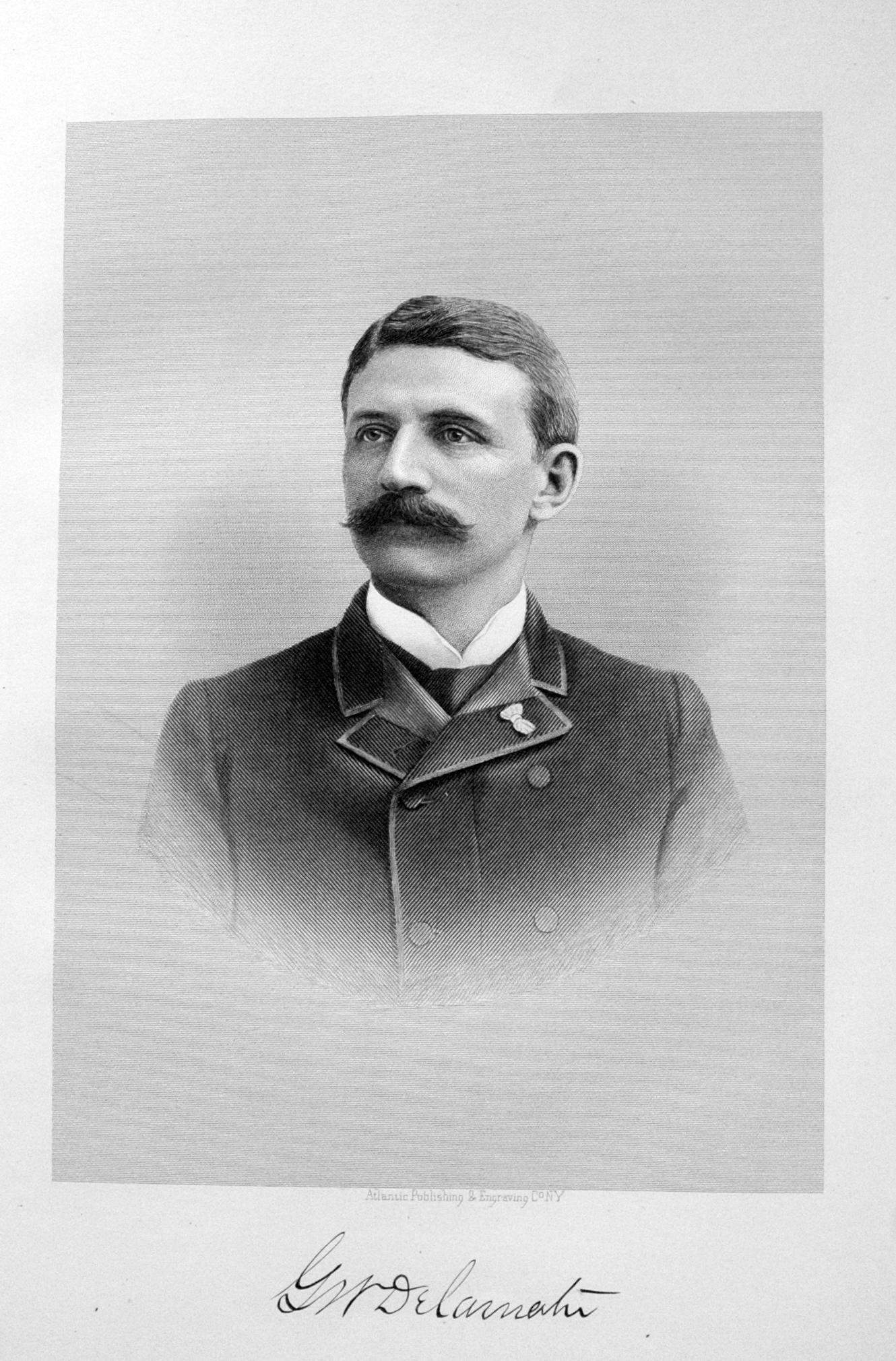
George Wallace Delamater. Photograph from the collection of the Pennsylvania State Senate Library.
In May of 1986, the Historical Society dedicated a carriage donated by Ralph Osborn of Titusville. His grandfather, James Osborn, purchased it from among other carriages which had been ordered by George Wallace Delamater, prominent Meadville banker. Some say that Delamater could not pay for the carriages because of staggering expenses incurred while running for the governorship in 1890. Others contend that the failure of the Delamater bank left him penniless. Perhaps both explanations are partially true; perhaps neither. Whatever reason for its sale, the fancy carriage touches upon an interesting but tragic part of the county’s history.
Seemingly, George W. Delamater had what it took in the late nineteenth century to succeed in politics – education, wealth, and the nod of approval from the political bosses. Born in 1849, the son of George B. Delamater and Susan G. Town, he graduated from Allegheny College and attended Harvard Law School. Having read law in the offices of H. L. Richmond, he was admitted to the bar in 1875. Two years later he became Meadville’s mayor – one of the youngest men ever to hold that office. It may have been Richmond who interested Delamater in politics. A prominent Republican and member of the Forty-third Congress, Richmond had demonstrated a genuine concern for the Native American equality. Some of this humanitarianism may have rubbed off upon Delamater, who displayed a similar concern for former slaves.
Some of his views obviously also came from his father. The senior Delamater had conspired with abolitionists and had assisted Morrow B. Lowry in helping Owen Brown (son of John Brown) and Charles Tidd, fugitives from the Harper’s Ferry raid, to find sanctuary in Delamater’s home in Townville, which one observer commented became an instant fortress. Governor Wise of Virginia had offered a handsome reward for the capture and return of the two men but they were well protected from bounty hunters by citizens of the county.
George W. Delamater joined a new Republican party that combined the interests of the businessman with those of the progressive reformer. He favored a program of fair taxation, aid to the veteran and farmer, and universal suffrage. He believed his party was dedicated to the reunification of the nation against what he called the sectionalism of the Democratic party’s “solid South.” The Fifteenth Amendment, granting the former slave the right to vote, was acting to break down the Democratic stronghold, he argued. His appeal was to the younger members of the party who generally wanted to forget the Civil War and take up the challenges of modern America.
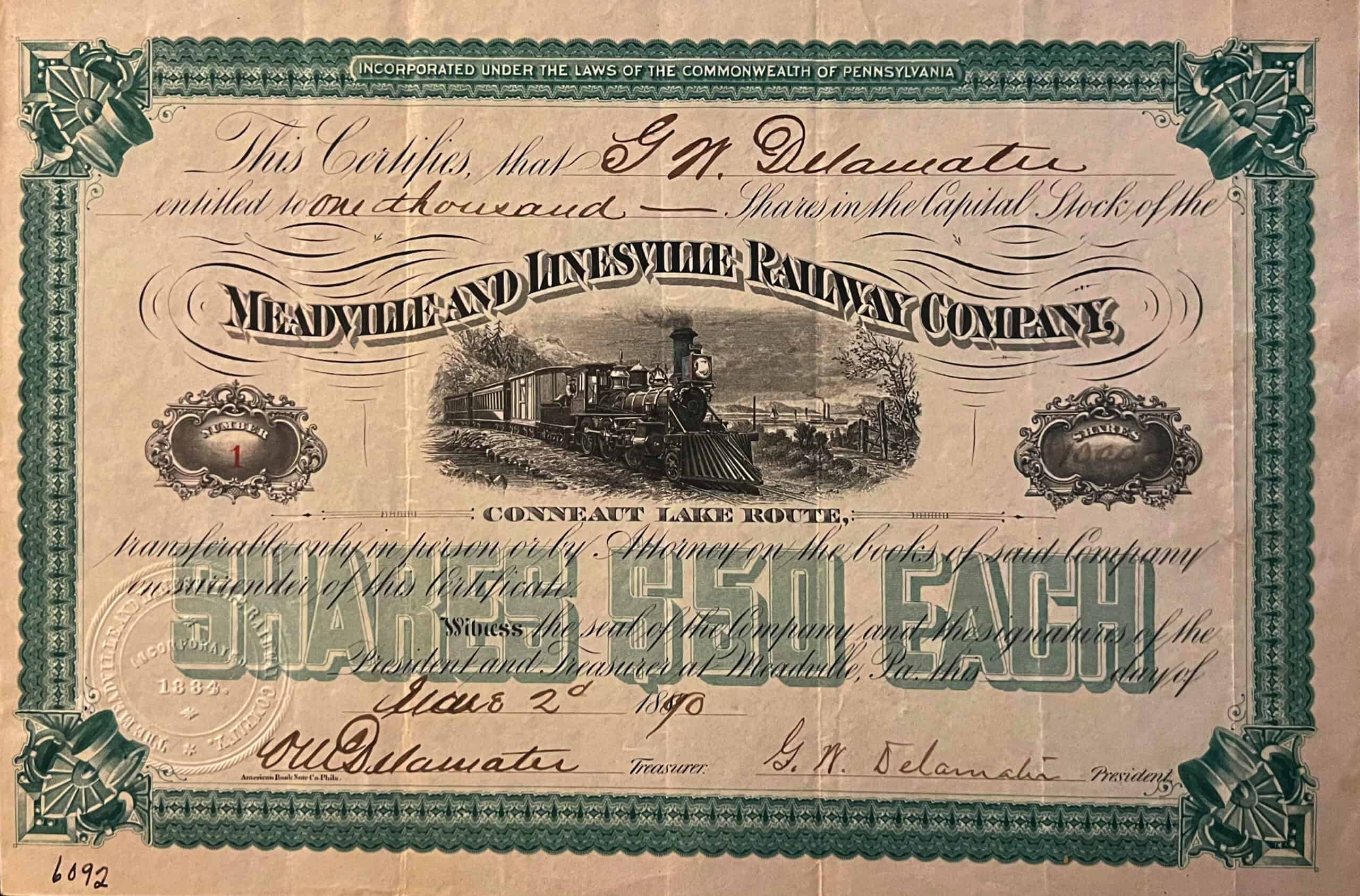
Stock Certificate to the Meadville and Linesville Railroad Company owned by George W Delamater. Collection of the Crawford County Historical Society.
One of the challenges was the increased need of capital for the promotion of industrial and commercial expansion. Financial capitalism propelled the banker to the foreground. In 1876 young George Delamater joined his father and brother, Thomas, to organize a banking firm in Meadville. With a fortune already having been made in oil, the family invested in real-estate, built the Delamater Block on the corner of Chestnut and Water Streets, and engaged in the financing of numerous enterprises, including glass works, the Meadville Railway Company, and the Meadville and Linesville Railroad. The initial success of the banking firm undoubtedly helped young George attain the recognition necessary to his political career.
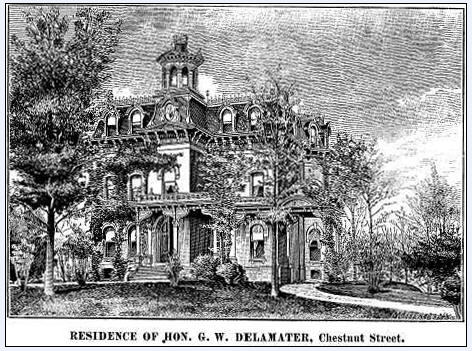
Delamater House on Chestnut Street, Meadville. Lithograph from the 1876 Historical Atlas of Crawford County.
Delamater’s big break in that rising career came in 1886 when he was elected to the State Senate. While serving in that body he impressed party bosses as a likely gubernatorial candidate. It was no secret that anyone aspiring to high office in Pennsylvania had to have the endorsement of Republican chiefs, Matt Quay and Don Cameron. Yet, Delamater was soon to learn that, having these twin masters of Machiavellian statecraft on one’s side, was not necessarily all that good. He faced opposition from everybody who linked the Quay-Cameron machine and its allies with those twin sisters of political barbarism – graft and corruption. In Meadville, Samuel Dick, leading banker and former congressman, headed a rival faction of the party that accused Delamater of being a simple stooge of the party’s bad guys. Supporting Delamater in the city was Quay’s political ally and editor of The Evening Republican, W. R. Andrews.
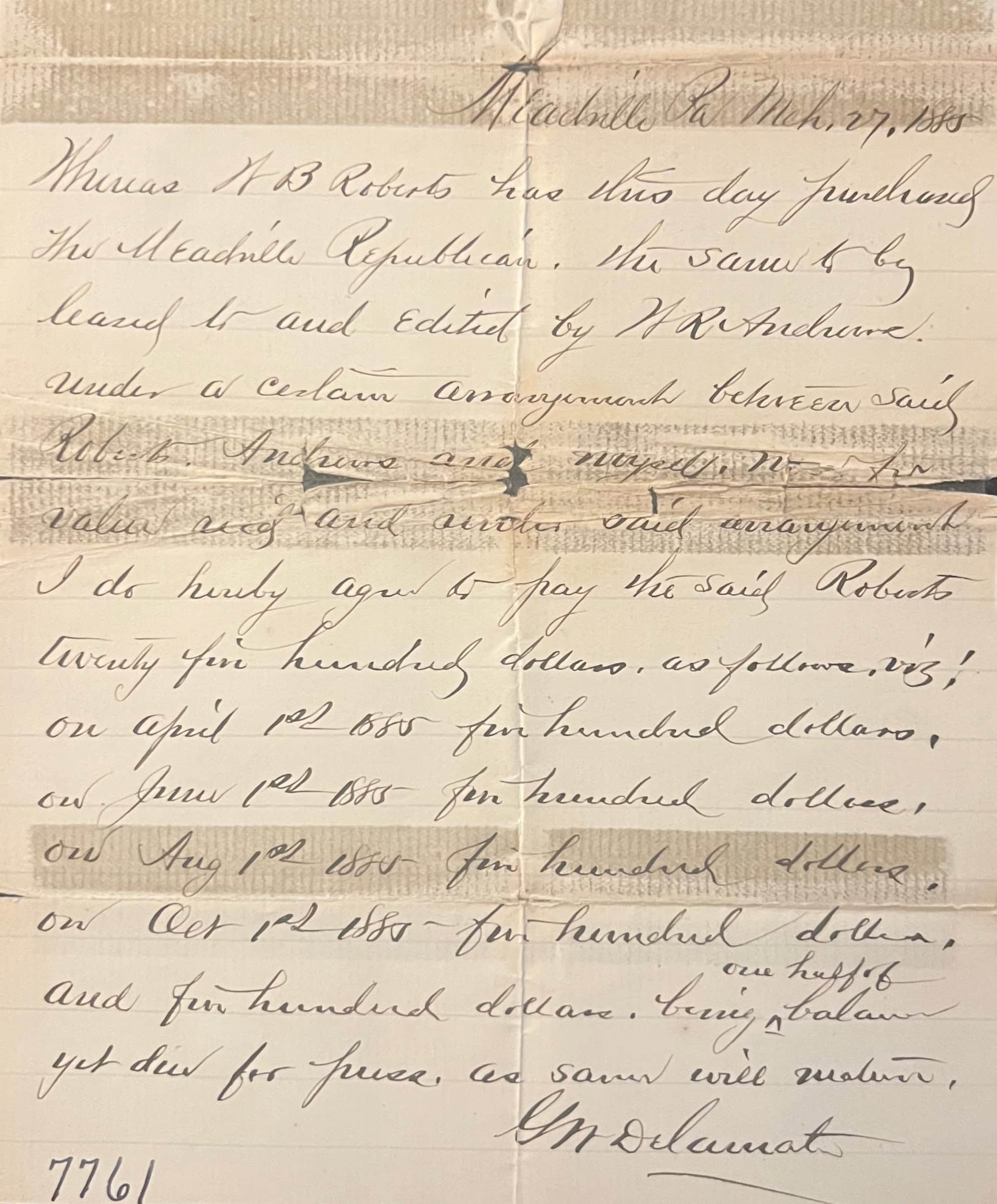
Agreement from 1885 between W. Roberts and George W. Delamater over payment to Roberts for fronting a portion of the “Meadville Republican” newspaper, which became owned by Andrews, Roberts, and Delamater. Collection of the Crawford County Historical Society
The Republican primary contest for governor in 1890 was between Delamater and the Adjutant-General, Daniel Hastings of Centre County. Although Hastings was the more popular candidate, it was the Meadville banker who was the recognized choice of the organization. Delamater was understood to be a favorite of Standard Oil and the Pennsylvania Railroad, two companies which Quay did not wish to alienate. Defying the sentiment of the Republican masses, therefore, he forced the nomination of Delamater. A dejected Hastings, young but shrewd enough to know that the future belonged to him, went all out for the banker.
The nomination led to open revolt and Delamater became the victim. He soon discovered his enemies. They quoted widely a statement attributed to boss Quay: “I have been making governors all my life, but I have never had one of my own. I am going to nominate Delamater and know how it feels to own a governor just for once.”
So much for principles. The Republican party in Pennsylvania was sick and the Democrats saw their opportunity. Whatever political dirt possibly existed, they made sure it was exposed. Ex-senator Lewis Emery produced affidavits charging Delamater with bribery, forgery, and perjury in a previous election. Furthermore, Delamater was accused of receiving a large sum of money from Standard Oil. Advised either to defend himself or withdraw his candidacy, he did neither. His silence only irritated the rank-and-file.
Apparently the affidavits came from reliable county Republicans. The Democratic press made the most of this revelation. The Meadville Democrat added that Delamater had $100,000 loaned to him by the state treasury, on which he paid no interest, but which in turn he loaned to county residents at from six to ten percent, clearing about $8000 for himself. Making the crime greater, the paper went on, the Delamater bank served as the custodian of county funds for the past nine or ten years and used the money for which again no interest was paid. Enough is enough. Why should the tax-payer, asked the editor, pay interest on his own money “to enrich a boodle politician?”
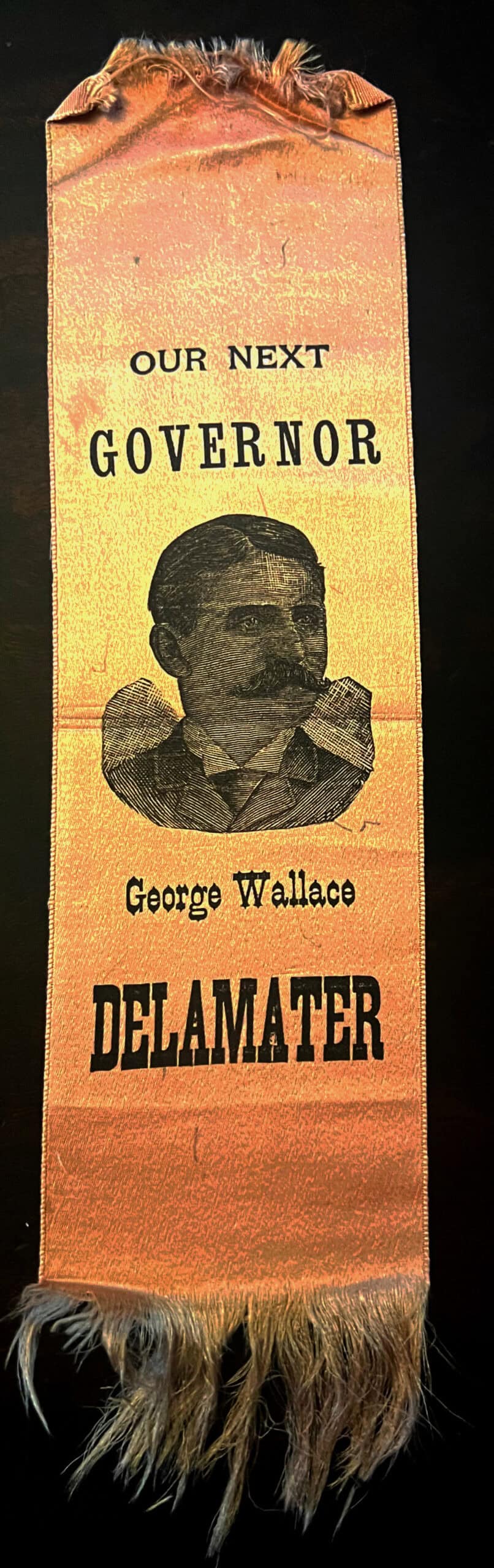
Delamater for Governor Ribbon from the Collection of the Crawford County Historical Society.
Republican voters registered a resounding rebuke to Delamater and Quayism. While most of the Republican ticket swept the state, the Meadville banker lost the contest to Robert E. Pattison by nearly 17,000 votes; in his own county he lost by nearly 1000 votes. This was an embarrassment. In the 1888 presidential election, Republican candidate Benjamin Harrison had carried Crawford by 2000 votes. Some people were shocked. While working on The Chautauquan in Meadville, Ida Tarbell went to bed early on election night, believing there would be a wide celebration of Delamater’s victory. After all, she thought, he had campaigned so brilliantly that he could not possibly lose. How surprised she was to read of his defeat in the morning paper.
Delamater’s record as a state legislator demonstrated a preference toward corporate interests which, as a group, had lost public respect. Independent oil producers, big labor, and the Grangers felt they had been victimized too long by those special interests allied with Quay’s machine. Democrats snickered that Quay and Delamater simply believed that a dollar dropped in a slot would turn out a vote. Not so. En-route to a vacation in Florida, Quay was asked why he believed Delamater had lost the election. Expressionless, the political boss quipped, “a lack of votes.”
The other side to Delamater’s disastrous year of 1890 was the failure of the family bank. Speculation was rampant with respect to the bank’s mismanagement and the possibility of criminal negligence. Only weeks after the election, the bank’s creditors were demanding payment. Public meetings were held. George W. Delamater admitted that the bank had made “grave business errors” and added that shrinkage of values in manufacturing, railroad and other enterprises had delivered a stunning blow to the firm’s viability. He labored diligently to bring order out of chaos, but a plan of settlement failed. Assets were sold, suits were entered, and savings of depositors were lost.
A few years later, Delamater went to Seattle, where he resumed his law practice. But he returned to Pennsylvania and settled in Pittsburgh. Here he engaged in the life insurance business with his son, Scott. Financial reverses and health problems plagued him, however. The loss of his father and then his son added to his grief and despondency. On the afternoon of August 7, 1907, he collected his personal papers in his offices in the Diamond National Bank, waited for his stenographer to go to lunch, pulled down the blinds, and put a bullet through his head.
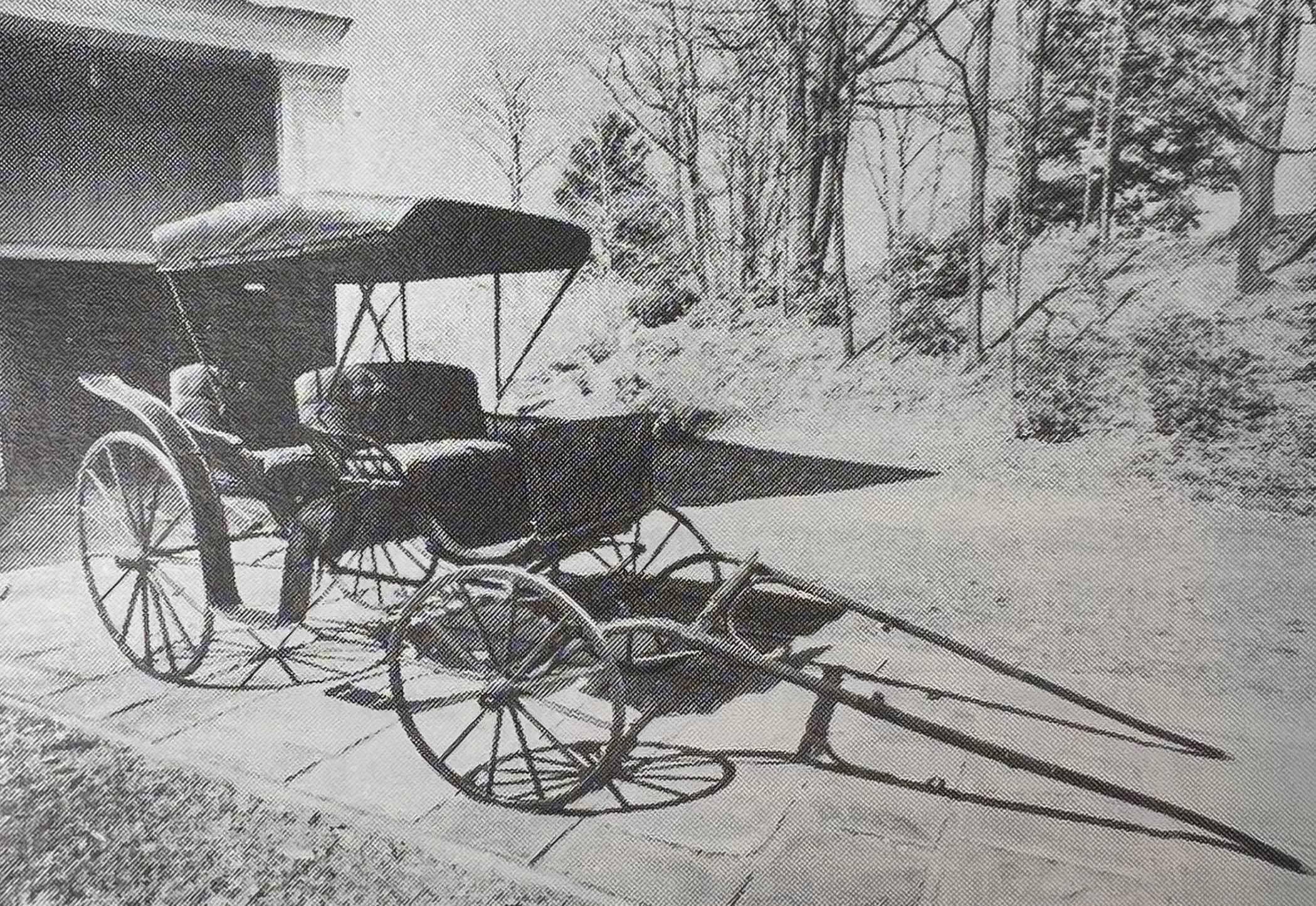
Delamater Carriage at Mount Hope: The Baldwin-Reynolds House Museum
Delamater’s tragedy did not mar the carriage ceremony in May of 1986. People attended to see a beautiful and completely rebuilt carriage which represents his goals and optimism. Ralph Osborn had wanted to have it placed in a museum for people to view. After his death, Mrs. Osborn arranged with Dr. Wayne Merrick, former president of the Historical Society, to have the Society consider accept the carriage and putting it on display at Mount Hope: The Baldwin-Reynolds House Museum and the History Building at the Crawford County Fairgrounds.

References
Editor’s Notes:
This article originally appeared in the Spring 1986 edition of the newsletter of the Crawford County Historical Society.
About the Author
Robert Ilisevich was retired Professor of American History at Alliance College, and retired archivist for the Crawford County Historical Society before his passing in 2022. He published local history books on Northwestern Pennsylvania, as well as numerous articles in journals in local, regional, and statewide publications. A former member of the Pennsylvania Historical Association, Ilisevich lectured on local history to civic groups and professional organizations.
Sign Up for Our Newsletter
Get the latest Crawford County Historical Society news and information delivered right to your inbox.
"*" indicates required fields