
Back to Articles
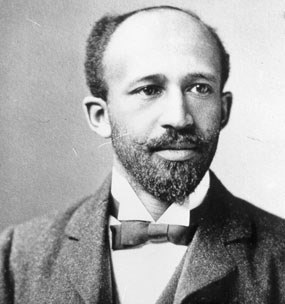
W.E.B. DuBois, Image courtesy of the National Park Service
This article written in 1903 by editors of the Meadville Morning Star and Meadville Gazette newspapers, covers an address Professor W. E. B. Dubois gave at the Unitarian Church twice during his visits on Thursday, December 17th, and Friday, December 18th, 1903.
DuBois spoke at great length on the topic of “The Transplanting of a Race” at the church as a guest of both the church and the Meadville Theological School. The newspaper details the topics discussed by Mr. Dubois as well as the reporter/authors input on Mr. Dubois speech. At this time, a great amount of study was being given to how the slave trade based on race was developed and how we as a people could advance from our complicated history.
Given the time period, this article contains sensitive topics and information and has been left, for the most part, in its unaltered original form. It has been only been edited or elaborated upon [using brackets] to ensure the material is clear, while still objectively left by the Society Staff in its original format. For more information on W.E.B. DuBois, see Encyclopedia Britannica online here.
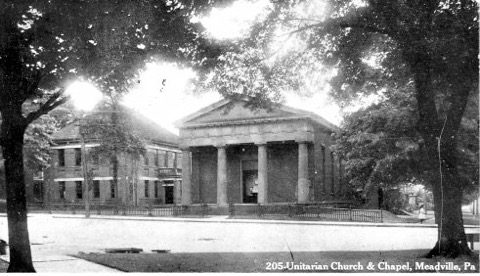
Unitarian Church, Meadville, Pennsylvania.
ELOQUENT ADDRESS, GIVEN • BY PROFESSOR W. E. BURKHARDT DUBOIS.
At the Unitarian Church — “The Transplantation of a Race” was the Subject-One of the Most Eloquent Addresses Ever Heard in Meadville.”
The announcement that Professor W. E. Burkhardt DuBois, of the University of Atlanta, at Atlanta, Ga.. would deliver a lecture at the Unitarian church Thursday evening, drew a crowd that filled the church, and, after hearing the first lecture, it is safe to predict that the crowd will be largely augmented this evening, when Mr. DuBois will again speak on what is popularly termed the “negro question.” The speaker was introduced by Professor Gilman, of the Theological school, who spoke of the importance of the question of which the lecturer was to speak., Mr. DuBois then stepped forward, being greeted with applause as he did so.
The subject taken by him for this first lecture was “The Transplantation of a Race.” In a simple and unaffected manner the speaker told the sad chapter of human history, in which is described the origin of slavery in civilized countries, and for nearly an hour held the closest attention of the cultured audience that heard him. Rarely, perhaps never, has so truly eloquent an address and one of such rhetorical finish and beauty been heard in Meadville. With no striving after oratorical effect, the spirit of true eloquence marked the entire discourse, and the story of the wrongs suffered by the enslaved negroes prior to the opening of the nineteenth century, was told with a terrible vividness and faithfulness to detail that made the auditors listen eagerly for every word that fell from the speaker’s lips.
Professor DuBois began his address with a discussion of the importance of the negro question, which, he said, was no longer a merely academic one, but one of the greatest with which his country was ever confronted. Going back through the centuries, the speaker said that the [race based] slave trade was really born in the middle of the fifteenth century, strangely enough, during the time of the great religious reformation and the Renaissance. The slave trade was the child of the Renaissance, said he. After an interesting survey of the country of Egypt, and of the ancient peoples of that country, their migrations and racial history, Mr. DuBois returned to the origin of the slave trade, as introduced into civilized countries, and which resulted, eventually, in the presence of ten millions of negroes in this country, a number greater than the combined population of Norway, Sweden and Denmark, or of Prussia[at that time], and more than all as large as the present population of Spain[as of 1903].
In 1441 a Portuguese navigator, Gonzales, landed on the coast of Africa in the Gulf of Guinea and took a number of Moors captive, returning with them to Portugal. The prisoners were men of importance and offered to ransom themselves if taken back to their homes, and consequently, in 1442, Gonzales returned to the African coast. As a ransom for his Moors he received 30 negroes, whom he took back with him to Lisbon, together with a quantity of gold discovered on the coast of the gulf. The negroes proved to be a great curiosity to the Portuguese, and, together with the thirst for gold roused by Gonzales’ voyage, immediately started a tide of navigation toward the gulf of Guinea. The subsequent rise of the traffic in human beings was graphically described by Professor DuBois, and a vivid picture drawn of the slave ships, upon which the unfortunate slaves were manacled together and crowded between decks with but fifteen inches of space allowed to each one. The mortality on these ships was often as high as 50%, and each morning it was necessary to free the dead from their living companions and throw them overboard. At one time there were 900 ships sailing from Liverpool alone, engaged in this terrible traffic. Queen Elizabeth at first opposed it, as did Pope Leo X, but to no avail. From 1442 until 1860, over 400 years, said the speaker, the Christian world [Western Europe and its colonies/protectorates] fattened on the stealing of human beings.
The speaker described in a vivid manner the growth of the traffic in Africa, and how the inhabitants were forced to flee from the coast, being tracked all over the continent until, said he, the whole country was traversed with paths, leading to the mouths of the Congo, Nile and Zambezi rivers. stained with the blood of the footsore, lined with the bleached skeletons of the dead, and echoing with the cries of the despairing. And this traffic, strangely enough, started at the time of a religious reformation; grew and flourished during an age in which Luther and Calvin lived and preached. King James I resigned, and while Shakespeare and Milton sang. For 400 years sharks followed in the wake of the vessels laden with slaves, for 400 years the Ethiopians stretched out their hands to God.
Professor DuBois’ closing sentence was: “Shall we judge a man according to his manhood, or according to his race and color?”
The applause was prolonged for several minutes after the speaker had finished, and many remained to express their appreciation personally to the gifted lecturer.
Sign Up for Our Newsletter
Get the latest Crawford County Historical Society news and information delivered right to your inbox.
"*" indicates required fields