

Back to Articles
Originally published June 14, 1868 – The Titusville Herald.
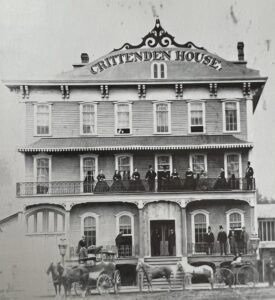
Crittenden Hall (Crittenden House) Courtesy of Drake Well Museum.
Redevelopment Now Dooms Old Landmark
Remarkably, the building described below still stands today (1965), although the
“Better Days” downtown redevelopment project may remove it in less than six months from the time these words appear in print.
It is Crittenden Hall, bounded and described as follows: just east of the former Barber, later Mitchell, insurance building, its north side on Diamond Street, its south on Spring; the west of the building touches the structure now occupied by
Stanley Owsinski, City Tailor – formerly Michael Ciaiola, shoe repairman – two stories, full of history, but now condemned to die:
September 14, 1868 – Reminiscences of Crittenden Hall
Crittenden Hall, now occupied by the Herald office, has had a somewhat eventful history. It was the first building of prominence erected here, When it was projected in 1861, Titusville was a post-village of 300 inhabitants. There were no buildings on East Spring Street, and Diamond Street was not laid out. The Moore House was a private mansion, in the midst of a thrifty orchard. The post office was kept in a corner grocery at the intersection Spring and Franklin streets. The old church at the head of Franklin Street, (now transformed into a paper-mill), was the only place for religious worship, and a narrow strip the of plank extending from church to the corner Spring Street, of constituted the only visible public improvement which the future “metropolis could boast of. The oil business was in the initial stage of development The Oil Creek Railroad was an enterprise yet dreampt of, and the stage-lines from Meadville, Union and Franklin were the only established means of communications with the outside world. But the rush of travel and fever of speculation had already commenced, and it required no extraordinary forecast to perceive in these refreshing drops the indications of an abundant
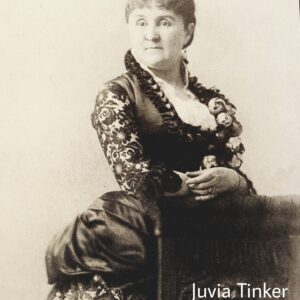
Juvia Tinker Hull
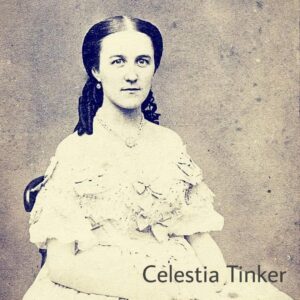
Celestia Tinker
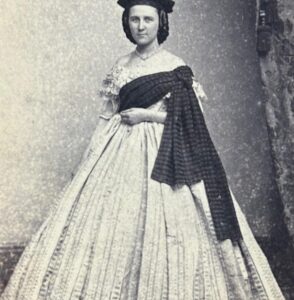
Flora Belle Tinker
Floor Gives Way On Opening Night
The hall was erected by Mr. Crittenden at a cost of about $7,000. On the opening night it was used for a musical entertainment by the Tinker family vocalists, since better known as the “Star Sisters.” The hall was filled to its greatest capacity, and the performance had scarcely commenced when a section of the floor near the rear, including about fifteen joists, gave way and precipitated a large portion the audience to the lower floor. The panic was indescribable. The remaining portion the audience, or most of them rushed to the windows and jumped to the ground, a distance of about fifteen feet. Strange to state only one individual was hurt—a man who was struck in the back by a boy who descended headforemost, and thus broke the force of his own fall. Several ladies were taken from the balcony in a swooning condition, but nobody was seriously injured. The people who had gone through the floor were in more critical condition. A bridal party from Spartansburg were exhumed with considerable difficulty from the coal hole. The stove, which had fallen through the floor, burst in pieces and immediately set fire to the building. All of the audience was taken out uninjured, but the building was soon wrapped in flames and was totally destroyed.
In fifteen days thereafter, the proprietor had the timbers on the ground for another structure, and the hall was rebuilt before the ensuing summer in a substantial manner. It is probably the strongest structure in Titusville. The lower floor was appropriated to a liquor store, the basement used as a refreshment saloon, and the hall leased for religious worship to the Episcopal Society, which had just then secured the services of Rev Henry Purdon, The Society occupied it only on the Sabbath. During the week it was used for theatrical performances, spiritualistic demonstrations, negro ministrels and dancing parties.
On one occasion, at a German dance, a dispute occurred which resulted in a general battle. The females were tumultuously hustled off, and the men remained to fight it out. The combatants were nearly equally divided, and the contest was waged with great fury for more than an hour, several men being rather seriously hurt, and some of them permanently injured. The difficulty was finally settled by Crittenden and a number of his friends coming in and attacking both parties, and clubbing them out of the hall.
Shortly afterwards the hall was sold to Ferdinand Fonda, of Saratoga, for $7,000. One year later it would have commanded $20,000. As a place of religious worship, it was occupied successively by the Episcopalians, the Catholics, the Presbyterians and the Baptists. In the winter of 1864-65, it was leased to O’Hara and Hill for theatrical purposes; subsequently to Rhodes & Pullman’s Varieties troupe, with a bar attached, and finally to Nelly Huntley’s concert saloon nymphs and harlequins, whose indecencies awakened such a storm of public indignation that the authorities were compelled to revoke the license. During the last two years it has had a very reputable record and enjoyed a considerable patronage for entertainments of the better sort. Its final transmutation into a printing office is probably the best that could have been devised. Thoroughly cleansed of its impurities, renovated and disenthralled, studio of the Art of arts, and the abode only of Printers’ Devils, there is no further occasion for casting cut!
About the Author
Originally published in the Titusville Herald on June 14th, 1965. The Herald is preserved at the Crawford County Historical Society.
Sign Up for Our Newsletter
Get the latest Crawford County Historical Society news and information delivered right to your inbox.
"*" indicates required fields