
Back to Articles
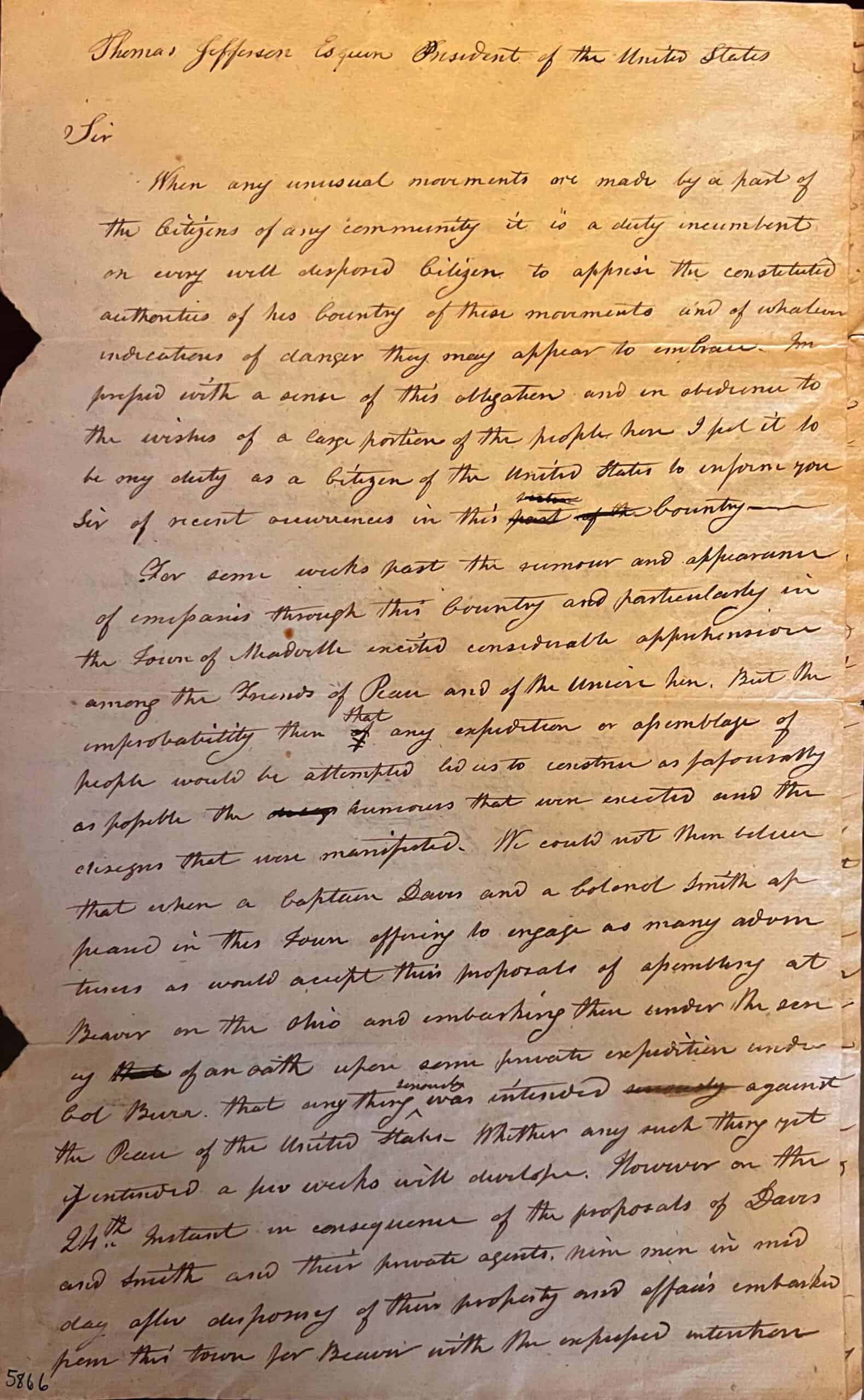
Letter from Patrick Farrelly to Thomas Jefferson, 1806, describing local activity relating to what would become known as the “Burr Conspiracy.” Collection of the Crawford County Historical Society.
The politics of Crawford County in the first decade of the last century were divisive and crude. Federalists and Republicans battled over land issues, internal improvements and banks. There was little they didn’t fight over. Writing to Thomas Jefferson in 1806, Patrick Farrelly, prominent Meadville attorney, intimidated local Federalists when he accused them of being unfriendly to the national government for taking part in a clandestine operation which became known as the “Burr Conspiracy.”
His remarks were to the point but mild. Other Republicans branded the Burr supporters as traitors and asked for their heads. Of greatest interest, however is the story of those Crawford Countians whose lives and careers were affected by the episode.
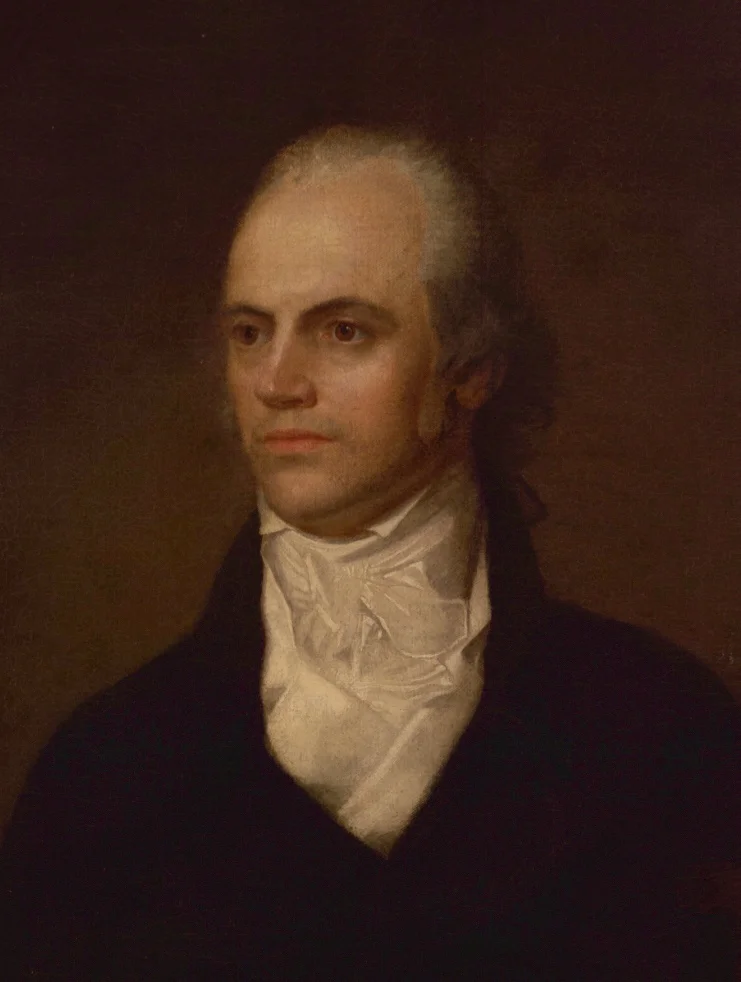
Aaron Burr by John Vanderlyn, c1803. Collection of Yale University Art Gallery.
Aaron Burr‘s own political career was brilliant but warped by imaginative grasps for power and glory. Rejected for the Vice-Presidency by Jefferson in 1804, Burr decided to run for governor of New York with a strong promise of Federalist support. But his efforts were frustrated by his chief New York rival, Alexander Hamilton. So bitter were the invectives between the two men that a duel ensued. When Burr killed Hamilton a young nation was stunned. With one fatal shot Burr had forfeited all rights to any political ambition he still may have had. Yet he was not through.
Burr fled West to avoid arrest and to exploit two dominant forces in the country at that time: expansionism and separatism. His exact plans seemed vague and contradictory; perhaps Burr himself was no more sure of them than is the historian today. Evidence suggests that he expected to be offered the presidency of New Orleans when it declared its independence of the Union. The next move might then be a war against Spain – a conflict that would be popular with many Westerners – with Burr himself possibly leading the revolution in Mexico. The end result would be a new empire carved from Spanish-held territory with Burr at its head.
However fantastic and incredulous the scheme may have been, the fact that many prominent men in the West attached themselves to it, and the fact that there was something mysterious about it, created a furor in the entire country this side of the mountains. Burr’s appeal seemed magnetic. Thousands of men pledged their support to him. Writing from Pittsburgh in Decem-per, 1806, Frederick Bates reported that Burr’s plans seemed complete and that many young men of education and wealth were descending the river. Burr’s agents had succeeded in selling a dreamy adventure to a bunch of starry-eyed pioneers.
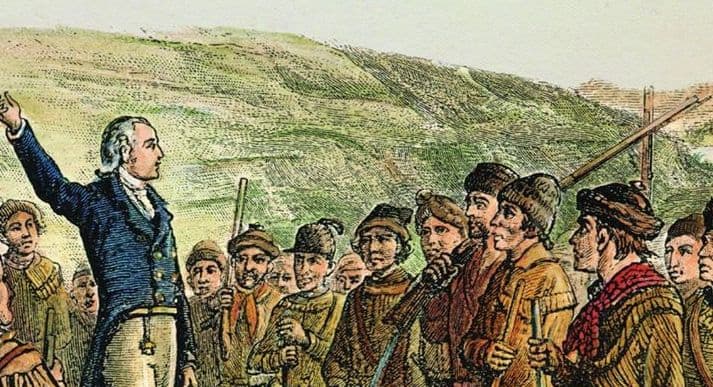
Soliciting support for Burr’s plans.
In his letter to the President, Farrelly mentioned two of these agents, Captain Davis and Colonel Smith, who came to Crawford County with tempting offers to anyone who wanted to listen. By November 24, 1806, nine men, again according to Farrelly, had been recruited and on that day they departed in canoes for Beaver Creek, the place of rendevous on the Ohio, to join the expeditionary force. Eight names of the nine are legible in Farrelly’s letter. They include Frederick Haymaker, Luke Hill, Hugh Allen, James Kennedy Carpenter, Owen Aston, William Davis and two chaps by the names of Burnside and Chidester. There may have been others but the historical evidence is lacking.
What reasons motivated these men to leave their families and friends for some unknown destiny, we’ll never know. Farrelly called them Federalists and claimed that some of them were fleeing their creditors. This may have been the case with Luke Hill, the legendary boatman and merchant who did go bankrupt. But insolvency probably was not that significant a factor. On the other hand, we cannot be sure that politics was the reason, either. Most likely, some combination of adventure, fame and fortune prompted these men to take the long boat ride south.
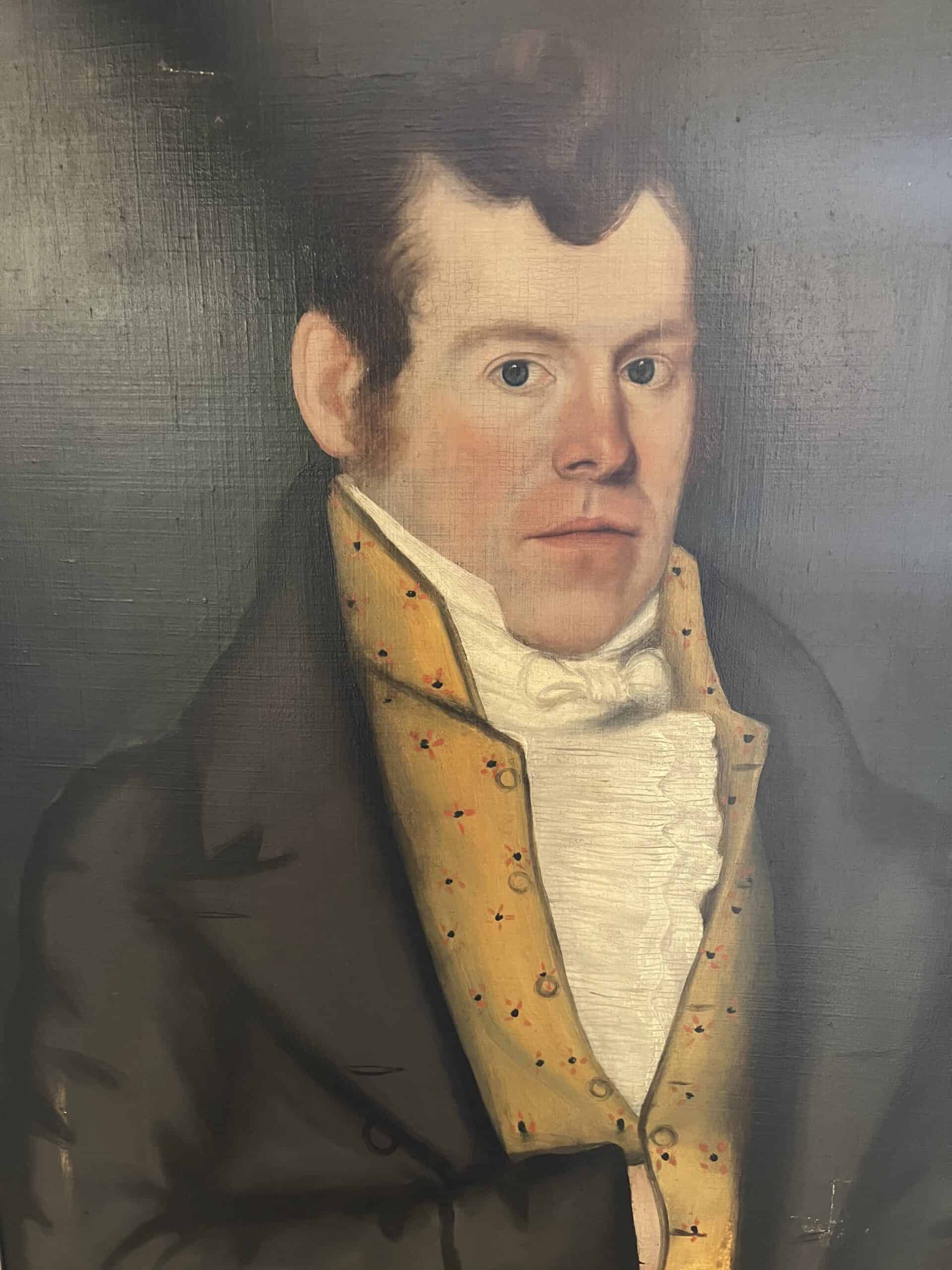
Thomas Atkinson, owned and editor of The Crawford Messenger. Painting attributed to artist James Bowman. Collection of Allegheny College – on loan to the Crawford County Historical Society
Some returned; some didn’t. Some met tragedy; others returned to resume a normal life or, as the editor of the Crawford Weekly Messenger, Thomas Atkinson, cynically called it: “the dull pursuits of civil life.” Luke Hill disappeared somewhere in Louisiana. William Davis, a promising talent in the prothonotary’s office, never found his El Dorado. His premature death in 1809 at Natchez, Mississippi, shocked his many friends back home. The tragedy was compounded when it was learned that his sister, Rache!, who had married another one of the nine – Frederick Haymaker – had died in childbirth about the same time. Family records indicate that Haymaker, former merchant, postmaster and Justice of the Peace served as Burr’s personal secretary. He never returned to the County.
Finally, there is Burnside, presumably William Burnside the brawny blacksmith of Pine Township, who returned and changed his politics, who dropped everything later to join Mead and others to fight in the War of 1812, and who was eventually murdered near his home.
Getting back to Atkinson, the fiery newspaperman left no doubts regarding his stand in this sordid affair. He pointed an accusing finger at Jabez Colt, agent for the Pennsylvania Population Company, who was very friendly with Captain Davis, Burr’s emissary in this region. It was Colt who recommended Hugh Allen to Davis, who then introduced him to Comfort Tyler, one of Burr’s principal agents. Furthermore, Atkinson charged Colt with malicious intent of joining the expedition himself until his “cowardly heart failed” upon hearing of Jefferson’s plan of reprisal against the conspirators. Atkinson was sure that Colt knew of and undoubtedly encouraged the financial backing that some men of Meadville were providing for the adventure. As a footnote, Burr had been one of the chief backers of the Pennsylvania Population Company, a land outfit which speculated heavily in lands in this part of the state.
Atkinson’s free-swinging journalism couldn’t help but affirm polarity of political sentiment in the community. Colt-Federalists-Pennsylvania Population Company-Burr – all together in a cause that smacked of treason! A man of Atkinson’s editorial talents couldn’t ask for a better set up. By implicating Colt and his Federalist friends, Atkinson had succeeded in rallying support for his Republican readers against two long-standing enemies of the poor settler: the land speculator and the rich who supported him.
Excitement was so great that the Republicans gathered before the Courthouse in Meadville on March 4, 1807, listened to an address by Farrelly condemning Burr and then paraded through the streets with an effigy of Burr which was ultimately burned in the public square. A wholesale riot was narrowly missed when the Federalists retaliated. They took offense at this demonstration, claiming that it was aimed at them. First they dangled their own effigy – a caricature of Farrelly – on a sign post in front of the Republican headquarters on Water Street. Afterwards it was taken down and carried with drum and fife passed the home of Farrelly, where it was “attacked and beat in a ruffian-like manner” by Peter Huidekoper, brother of Harm Jan.
What happened after this is anyone’s guess. Old scores were settled as some fighting broke out. A number of arrests followed. The medical journal of Dr. Thomas Kennedy shows that on that day Peter Huidekoper had to have a number of wounds dressed. Atkinson must have delighted in Peter’s misfortune for he didn’t particularly care for the Huidekopers. The high-strung Peter, regardless of his politics, if he had any, was a noted brawler. His drinking habits and his fisticuffs eventually cost him his job with the Holland Land Company at Batavia.
Regardless of the excitement and the amount of space given in the newspapers to Burr, to his enterprise, and to those men whose lives were affected by the chain of events, it is hard to assess the political capital the Republicans may have gained from all this. They did attain a smashing victory in the 1808 elections but they were unable to dislodge Federalist strength in Meadville and Mead Township. Political conservatism would remain strong in these areas long after the Federalist Party faded nationally and locally. Many bad feelings caused by the Burr incident would heal in time, but political factionalism deepened. A permanent two-party system emerged and one cannot help but wonder if the lively events of 1806-1807 contributed to its development.

References
Editor’s Notes:
This article originally appeared in the Winter 1977 edition of the newsletter of the Crawford County Historical Society.
About the Author
Robert Ilisevich was retired Professor of American History at Alliance College, and retired archivist for the Crawford County Historical Society before his passing in 2022. He published local history books on Northwestern Pennsylvania, as well as numerous articles in journals in local, regional, and statewide publications. A former member of the Pennsylvania Historical Association, Ilisevich lectured on local history to civic groups and professional organizations.
Sign Up for Our Newsletter
Get the latest Crawford County Historical Society news and information delivered right to your inbox.
"*" indicates required fields